Grace is free, but it’s not cheap

Read: Deuteronomy 7:6-16

Have you ever noticed that we love hearing about God’s grace, but we are not so keen to hear his call to obedience?

Do you ever wonder how God feels about that? Maybe he feels like a lover who showers their mate with affection, gifts, and security only to find that their mate is indifferent and does not reciprocate. I don’t know: would God be more grieved, or broken, or angered? Maybe all of that together, and more.

Grace is free, but it is not cheap. If we have little desire to obey, we cheapen whatever it cost God to give grace in the first place. The cross of Jesus tells us the cost to God was beyond our imagination.

If we have little desire to obey, we cheapen whatever it cost God to give grace in the first place

In Deut 7, we hear how God acted in grace to draw people to himself. And as much as we believe in grace, the verses which follow remind us that we still have a deep sense of responsibility to obey. They also remind us that how we obey will have profound consequences in our lives.

Obedience is no burden. Is a lover burdened when they respond to their mate with warmth, love, and commitment? Is a lover burdened when they rest on the shoulder of their mate, keen to do whatever will express their joy and happiness to be in relationship? Obligation doesn’t even come into it. This is all about opportunity, privilege, and joy.

Our responses to God should be like that. As we obey God, we get to live for the sort of world that he delights in. His love is our motive. His love is the cause. His love is the goal.

Q: Think of one area were you have been resisting obedience to God. Think about how much he loves you, and what that love cost, and then make a resolution to change some specific behaviour and attitudes

The Interference of Self

Read: Heb 13:1-6

Sometimes when I am met by a need or a context where I know I should move forward and respond, I push back and either procrastinate or simply turn away.

Why do I do that? Is it fear that my incompetence might be exposed Is it a sense that I might not be safe? Or is it prejudice? Or some combination of a whole raft of reasons? This passage speaks of ministering to prisoners (v.3) – do I fear their violence, and back off? We also read of strangers (v.2) – can they be trusted? Sometimes I am so prejudiced and governed by insecurity with moves me toward self protection and avoidance. Too easily, my fears blind me to what I really need to see. This is the interference of self.

Quite often the truth we need to hear is uncomfortable

Quite often, the truth we need to hear is uncomfortable. It interferes with the ‘realities’ we construct to protect ourselves from inconvenience. If one of these uncomfortable truths threatens my material wealth, my financial independence, or my leisure, I often try to push it away. Sometimes, I don’t even think I realise what I am doing. Yet through defensiveness or dismissal, or something as harmless as well directed humour, I persist in my denial. I would rather that people affirm me, and confirm the sometimes lesser story I have chosen to live at that time.

Well, there is only one affirmation that really matters. One reality worth living for. On Kingdom deserving the focus of my life, one relationship that brings love, peace, life and hope. And it is God (v.6). I don’t have to worry about what others may think, because living with God, or rather Him with me, I have all I need to survive the day.

Q: Does relationship with God really make that much difference to you? Leave a comment and tell us what you think.

Watch what God does, and then you do it

Read Eph 5:1-20

The command to ‘imitate God’ seems impossible to honour. How can failed and fallen human beings imitate God? True, but that’s not what Paul is getting at. He is asking us to imitate God in his values and character toward people and their world. This makes it more exciting than impossible, right?

The immediate context has to do with forgiveness and love, but as we move through the chapter we hear the writer dealing with the broad scope of life, and how relationship with Jesus transforms it.

Make no mistake, we do these things because God is making us new through Jesus, and because he is at work in us (Eph 3:14-21). God’s work through Jesus means the changes he calls us to are not impossible. What God calls us to attempt he will enable us to achieve.

With that in mind, here are a few questions to get you thinking about how you can watch what God does, and then start to do it:

* How can I show grace and forgiveness to those who have hurt me? Who are the people who are waiting for my words of grace? What will I do to bring grace in these situation?

* How can I help the people around me to thrive? What are their needs and how can I address them?

* How can I help my community to show grace to the poor, the needy, and the helpless?

* How can I help my neighbourhood to be a community that God would delight in? What needs to be done, or developed?

* What injustices are there around me, and how can I join others in addressing and correcting them?

Q: If we ere to do these things consistently, do you think Christians and the church would have more credibility?

Q: What other questions might be helpful as we consider this topic?

Not much to look at…

Read: 2 Cor 4

I don’t like being weak, and I certainly don’t like being perceived as weak. So I engage in the stupidity of covering up. It is a clumsy attempt to project some other reality, one of relative strength and having it together.

I think I shortchange God when I do this. Paul was a man who was in touch with his weakness. I can imagine his CV saying ‘excellent education under Gamaliel, and later, Jesus himself, but I am not much to listen to, and i have several persistent and debilitating personal issues…’ Would you hire someone like that?

When I seek to give the impression of strength, the focus is on me, and the Gospel is masked. We have all seen mega churches which advertise their senior pastors with larger than life airbrushed images. What images might there have been outside Paul’s church (even though he was regional and itinerant, and not bound to a ‘church building’). A cross? A gallows and noose? A broken terra cotta pot? A picture of disability?

Weakness is God’s favourite work context

God uses weakness to reveal the beauty of his grace and character. This may unnerve us. Even so, that is how it is. He chose weak and underdeveloped Israel. Abraham and Sarah were old and past it. Moses was not a great speaker. David was too small for a soldier’s armour. Jesus was viewed as a reject, and gathered other rejects to himself. The cross is seen as foolishness. Jesus’ followers, small in number and uneducated, were given the task of making disciples of all nations.

Weakness is God’s favourite work context. Weakness is how he perfectly shows his power (2 Cor 12:9).

So I have my weaknesses and so do you. I should not feed them, thinking that a worse situation will end up being a context for greater power. That’s like sinning more to get more grace (Rom 6:1).

So while I work on my weaknesses, I will simply pray that God’s grace and power will be at work despite my weaknesses. I will pray that God’s work, God’s character, and God’s grace might be more clearly seen. That my work, my character or gifts might not be the focus.

I am a jar of clay. A cracked clay pot. So let the treasure of grace and the wonder of Christ be more clearly seen.

Q: How might God use your specific weaknesses and frustrations to reveal his power today?

If you’d like further encouragement to be open about your weaknesses, check out Michael Hyatt’s excellent piece, published yesterday: ‘Tell Your Story, The Good and The Bad’

Fuel for the fight…

Read: Leviticus 26:1-13

The book of Leviticus is a challenge at the best of times. One writer says ‘The contents of the book, perhaps more than any other book of the Bible, see so removed from the daily life of the contemporary Christian that one is tempted to avoid the effort.’

Even so, maybe today’s reading is a cameo of the book’s purpose, and perhaps God’s purpose, too. These 13 verses rock between the ‘I’ of God’s action and the ‘you’ of our response.

As they affirm the Lord for his blessing and grace, and call us to specific behaviour and attitudes, they also present a powerful reminder that the capacity for people to respond and obey starts with his work in our lives.

I know some Christians think differently about this, but I have never been able to accept that we initiate faith and belief and spiritual movement, and only then will God love us. It seems to indicate that God is somehow waiting for us, or dependent on us. I don’t think a God like that is much of a God, really. God is not waiting for us to act: He has acted. He has drawn us into grace, and we get to respond. Sometimes it seems as though we have come up with the idea, but God has always seeded that thirst and exploration in us. And the fact we think it started with us just shows how creative and gentle God can be.

Leviticus teaches us these truths. The central plank of the book, amongst all the other detail, is the Day of Atonement (Lev 16). God graciously acts to forgive rebellious and sinful people. In Lev 20:26 God says ‘You are to be holy because I, the Lord, am holy, and I have set you apart from the nations to be my very own.’ So our motivation to obey find its source in his lavish grace.

Have a look at the passage again, and notice the rhythm: ‘I have acted’ and then ‘you will do this in response.’ The story of Jesus fits this same rhythm perfectly: while we were still sinners, enemies of God, and rebels, Christ died for us.’

God’s lavish grace is the fuel I need for life’s fight

I find this reality of God’s lavish grace is the fuel I need for life’s fight. Isn’t this the wonderful ‘resource beyond myself’ that enables me to give even when I am at the end of my rope? For sure.

Truth be known, this truth is not well enough known. Is it any wonder that I tire so consistently of doing what God calls me to do? Is it any wonder that sometimes it feels as though God is far from me, even though I know he never is?

And then, no wonder that I am surprised when God answers my tardiness with even more love and grace.

“I will put my dwelling place among you and be your God, and you will be my people. I am the Lord your god who brought you out of Egypt, so that you will no longer be slaves to the Egyptians; I broke the bars of your yoke and enabled you to walk with heads held high.” [Lev 26:11-13]

Q: What makes it so hard to believe that God just keeps giving grace, even when all we give him is brokenness and failure?

No longer I…

Read Gal 2:11-21

The theme for our readings these last days has been ‘The Lord is with us’. Could there be a more relevant passage than Gal 2:20?

“I have been crucified with Christ and I no longer live, but Christ lives in me.”

I am deeply moved by this reality.

All ancient religions, and many modern religions speak of people making places where God can dwell. Temples. Holy places. Attitudes of contemplation. These are the things people create to so God might dwell with them.

Instead of people creating a place where God dwells, God creates a people in which he dwells.

The Gospel of Jesus is very different. Totally opposite. Instead of people creating a place where God dwells, God creates a people in which he dwells. In Jesus, you are a new creation (2 Cor 5:18). You have become his temple (1 Cor 6:19, 1 Cor 3:16,17) It is remarkable that in a place like Athens Paul would remark that it is not God who lives in our Temples, but that we live in him (Acts 17:28). In Ephesus, a city dominated by the temple of Artemis/Diana, Paul makes the point that the Gospel is not about gods made by human hands, but that by grace we have become God’s workmanship (Eph 2:8-10).

Could there me a more transformational reality that the fact that God lives in you? That through Jesus he is recreating you after his image and likeness? (Eph 4:24)

Q: What difference will it make for you today to know that at because of Jesus, every moment He lives is you and is with you?

Building a Community of Men

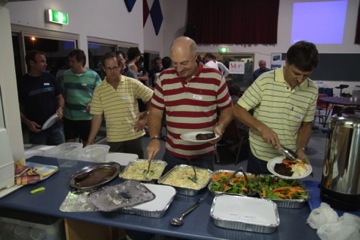
Tonight was the first get together for The Meating – a new men’s community at Redlands CRC. There were three basic elements to what we did:

1. Great food: We ordered prime Rib Fillet, 25mm thick from Fitzsimmons in Carindale, and it was delicious, melt in the mouth beef. With some salads as sides we ate really well

Food


2. Great company: 50 men from all age groups and walks of life. Some have followed Jesus for a long time. Others were still wondering what it was all about. Across the board the blokes loved the night. Great community, wrestling with real issues, and some time to break it down in groups of three or so.

3. A Great speaker: Peter Janetzki local counsellor and host of Brisbane’s 96.5 FM’s Talking Life opened up the issues of (amongst other things) authentic masculinity, passivity, cultural change and its impact on how boys and men develop, and what this means for men who follow Jesus.

PJ


It was amazing that after 30 mins there still wasn’t a sound in the room. Every man was locked on, thinking through what it would mean for them to build a community where men and boys were encouraged into strength and action with character. We knew that we needed this.

So many models of masculinity today have little to do with strength and action with character. We see plenty of strength and action from our sporting heros, but so very little good character. Character cannot be legislated or mechanically applied. It’s interesting how when you look at Jesus, we see strength, action and character in perfect balance. Jesus presents an incredibly attractive picture of restored masculinity.

One of the things ‘The Meating’ will seek to do is create some something of the ‘village’ or ‘community’. It we can do that in a way that shows the Kingdom, it might just end up being a village that raises better children.

Question: What do you think are the biggest challenges to authentic masculinity today?

Why you should keep serving, even though you want to quit


I want to thank Frank and Sasha for their comments on my post “The Good You Do is Never Wasted”. I thought it best to respond with a follow up post, so here it is.

Frank, to spend your life and energy caring for someone who does not appreciate your care is an incredible act of selflessness. Or think of Sasha, who continues to provide care and guidance even though her efforts are often met with defiance? What will keep us going in these situations?

I do not want to be simplistic about any of this. None of this is easy. And you might not want to hear it, but the truth is sometimes the situation stays bad. Sometimes it gets worse. We have to be realistic about this.

sometimes the situation stays bad

So: why persist?

First up: when we keep serving in a hard situation, we are like God and we show his character. God’s core business is to make life thrive, and to bring order out of chaos. And we are created as his image. When we keep on serving we are his workmates. And his promise is that he will strengthen us and help us. He promises to be with us, even when we walk through the valley of the shadow of death.

Second: take a step back and ask ‘What am I learning? What is God teaching me in this?’ How is he using this challenge to shape me? Will his experience prepare me for some other challenge that may still lie ahead? I know it can sound a bit cliched, but sometimes even cliches are true.

Third: think of the person or people you are serving – Is it a waste for them? They may be defiant. They may not appreciate your care, or communicate their thanks. But some time later they may be able to look back and remember that someone like you cared for them. Or they may enjoy the comfort you provide, and for one more day their life may be more bearable. That fact that it remains unacknowledged does not change the reality that you are doing a good thing.

Or consider this: What do others see in what you are doing? Might they see God, or his attitudes, or the character of Jesus? I can think of a couple of people who just keep giving, and who just keep serving, and I see God’s grace and presence so clearly in what they do. But I bet sometimes they are sick of it.

Fourth: remember why you signed up. Sasha’s concept of remembering her calling is great. But let’s take it just a bit further: I think it’s better to remember the promises of the God who gave the call. Jeremiah. David. Other Psalmists, they all wrestled with their call, but you always hear their rock solid confidence in God, even in the midst of their deepest challenge. Check out Ps 73. God is faithful, and his lovingkindness is everlasting (Ps 136). He will never leave you or forsake you. And Jesus’ death and rising in victory is our absolute guarantee that God can be trusted.

When you are tired and drawn the easiest thing to do is to lose perspective. Here’s a few things to do to stay focused in doing good, even when your experience is bad:

Read the Gospels. Jesus was always under appreciated. He suffered rejection and rebellion from people on a daily basis. His support team ended up forsaking him. But he kept serving. He loved rebels. He died for sinners. He prayed for the people who persecuted him. He just keep loving and giving. Not only will his story inspire you, he will give you what you need to keep announcing and anticipating his kingdom through your selfless service. He lives in you through his spirit, and he knows what you’re up against. You are not alone.

Get enough rest. It’s not always possible, but try to get enough sleep. Sleep deprivation will lower your patience, your capacity to show mercy, and your ability to function. It will get you thinking about yourself and resentful toward the ones you are serving. More sleep will increase your capacity to cope.

Exercise well. Walk. Ride. Whatever. Choose activities that are highly flexible, which you can do anywhere and pretty much any time. And because Leonie reads this blog, I also have to make a confession: I have to lift my own game here. Over the last year I have dropped my rhythm and let my bike riding go. Stupid. So I have to get my own act in order. I am going to hate it, but I know when I exercise it’s not only good for me physically, it helps me spiritually and emotionally. I always cope better when I exercise.

Engage in some “Spill your guts” therapy. Find a friend and pour your heart out to them regularly. They won’t often know what to do. That’s OK. The best thing they can do is listen to you and pray with you. Such friends stick closer than a brother. They become an embodiment of God’s grace.

To cap it off, just a few weeks ago I heard three people tell their story of how God has worked his grace into their lives. One was embittered against God with grief. Another was an agnostic. Yet another was a rationalistic atheist. But God used the words of people in their lives to draw them back to himself. In those stories we were given a glimpse of how God works though people all the time. It’s probably only rarely that we see the outcome, even so God works through our words and actions all the time. It’s only rarely that we see the outcome. So, keep serving, believing God will keep doing his work through you.

As I said above, sometimes the outcome is years down the track. Sometimes it’s an outcome is a completely different context. But perhaps the outcome will only be seen on The Big Day, when at last everything will be made right. And we will all honour God for his work through Jesus in people, who kept on doing the hard yards because they knew it was right and they knew God was with them.

So, no Frank it is never wasted. And yes, Sasha, it does make a difference, and especially to that one.

Grace and peace: Dave

Location:Wellington Point,Australia

So hard to watch: coming to terms with your own limitations

Today was not the best day. It turns out that Mum did not sleep too well. To be expected, really. It was her first night in Lovely Banks. The bed will be different. She will wake up to different surroundings. She will wake up tired. And all of that will compound to add to her confusion.


Old man and woman on a bench watching the sunset, watercolour by Erin Groenenboom

Dad and I visited at about 10:00am, and briefly spoke of our plans for the day. We would travel to Warrnambool, organise a phone, and maybe look at a few things Dad needed, and then make our way back to Cobden. Then there was a lamb roast to be cooked, and I was goIng to season and bake the potatoes and pumpkin.

We made the trip to Warrnambool, and finally made it back to see mum at about 3:30pm. By that time, however, it was clear her disrupted night’s sleep was taking it’s toll. She was rambling a little, and confusing her feeling
ill at lunchtime with having to go for a long walk away from home and thinking she was going to ‘croak’.

I made it back a second time to find that Mum was even more confused by that time. We watched as Mum rang the buzzer to go to the toilet. The carers came, lifted Mum to her feet, and took her to the toilet. Jo remarked “up to yesterday, we would have been doing that, or Dad would have been doing that, and I’m so glad we don’t have to anymore.” It’s not that we couldn’t be bothered, or that we felt the task was beneath us. I think Jo captured it when she put it in terms of being broken.

Love always has a cost. And for Dad and Jo, the cost was knowing that they had reached the limit of what they could do. The cost was realising that loving Mum meant they had to provide a level of care that they could no longer deliver. We struggled to accept the limits of our own love.

We struggled to answer Mum when she asked why she could not go with us, why we could not help her up, and why Jo and I were the only ones who were ‘allowed out’. We bit our lip as Mum came to terms with her reality as best she could…

“Can we get out? Can we leave now? Are you and Jo the only ones who can leave? Do I have to stay here by myself, then? On my own?”

“Yes Mum, you need to stay here, and Jo and I have to go. We have to be home by seven. The nurses will come and help you get changed. No, Mum, we cannot do that, they do, that’s what they are here for…”

In that moment, I remembered that as a young father, I occasionally had to leave our second youngest, Melody, at day care. She would be crying, “Daddy! Daddy! Daddy!”, pleading for me not to walk away. But I did. I walked away and left her in day care. It was about the hardest thing I had to do.

…we just have to walk away. We have to go, and now

This afternoon I remembered that experience. When Mum was questioning why we could leave, and why she couldn’t. I made eye contact with Jo and mouthed the words, “we just have to walk away. We have to go, and now.” I knew the longer we stayed, the harder it would be to leave. So we kissed Mum on the forehead, and said we’d we there tomorrow. And then we walked away.

Grace and peace: Dave

One small step for Mum & Dad, one huge step for love

Mum normally does not get going until about 8 or 8:30. Today, she was up well before that. Probably around 6:30am. When i asked why she was up so early, she said it was because something big was going to happen that day. And again I am reminded that Mum is fully aware of what this day will bring.


Mum & Dad, walking into Lovely Banks in Cobden

We’ve talked about that, my sisters and I. We’ve often wondered whether Mum really has a complete understanding of what is happening. I mean, how do you just move away from your husband of 57 years? How do you leave your family home? How do you just walk into a place like Lovely Banks, knowing it will be your last move before you die? How do you do any of that without breaking down, or worse, throwing a tantrum and digging your heels in?


Mum & Dad, December 19, 1953 married at the Leigh Memorial Church, Lithgow, NSW

I can think of two reasons. The first is that even though Mum is suffering her delusional fantasies, and she sometimes has trouble interpreting reality, she has enough of a handle on what’s going on to know that she needs this level of care. The second is that she knows Dad can’t be here carer anymore. Dad has chronic back pain, and so the lifting, the care, the pure and simple everyday being there was just getting the better of him. It was nothing for him to be up two or sometimes three times a night helping the disoriented love of his life to the toilet and back to bed again.


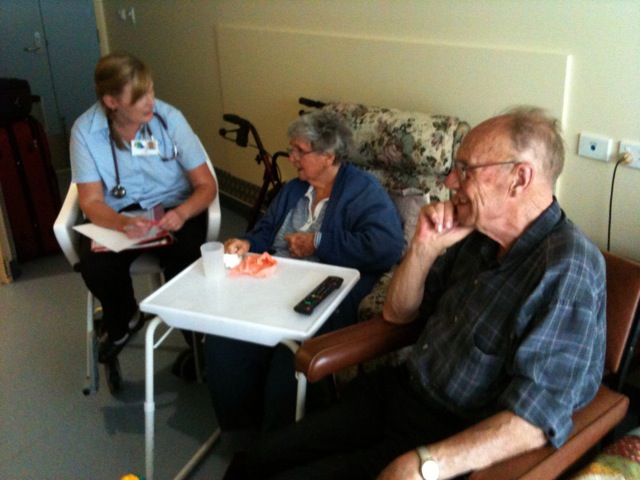
Settling in. The wonderful staff take Mum and Dad through some basics.

Dad told me tonight that this afternoon he has asked Mum, “You know why this was necessary, don’t you?” and Mum had said “Yes, because we couldn’t go on doing what we were doing anymore.” Some nights, Dad only had three hours of sleep. If even young guys have trouble coping with that, we can understand a 78 year old will never be able to manage it..

I think this says a lot about the love that Mum & Dad have for each other. Love is not doing what you want. If it was, Mum would still be home, irrespective of what harm it brought her and Dad. But that is not what love is. Love is a decision. Often and joyous one, but sometimes a painful one: to deny yourself, your wants, your comforts, and to consciously and selflessly do what the other person needs. So, as hard as it is, Mum decided that she had to make the move. That level of maturity, and that depth of love, is inspirational.

It’s a divine decision. It’s the sort of decision Jesus made, when he turned his back on his glory and made himself nothing for us. He denied his own wants and comforts, and instead he consciously and selflessly did what others needed.


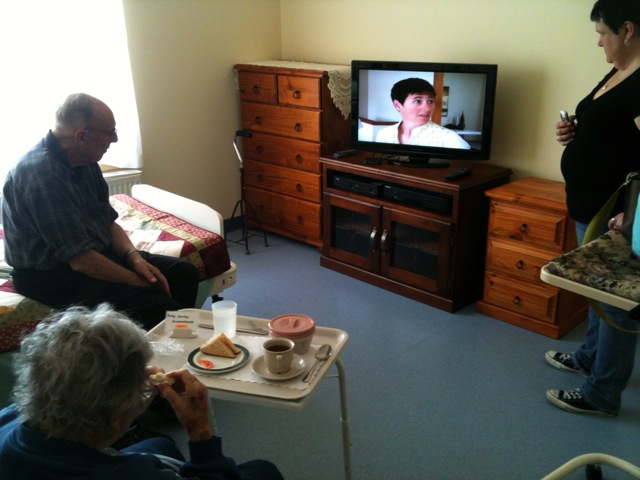
Mum’s new room on Day 1

So we lie down in our beds tonight. Dad is alone in his room. Mum is alone in hers. And there is love. And there is peace. And we are thankful that God has led us through this day.

Have a read of Psalm 91. It’s brilliant!

Q: What do you think about love being defined as self denial and a decision to serve the other? is this actually doable? Leave a comment…

Grace and peace: Dave