Familiarity and Fear

My reading this morning took me to several places: First Psalm 18 – a wonderful Psalm of God’s mighty protection, and his ability to bring victory to his people in battle. Then I read Ps 94, which spoke about the Lord’s justice to those who do evil.

I found myself wondering about our tendency to see God as a mate, to talk to him as if he is any other person in the room. As if.

God is to be feared, deeply respected, bowed before and submitted to. We don’t like this language – we think we’re better than that. Truth is, we aren’t. We are deeply flawed and woefully fallen people in need of repentance.

This creates a tension in our hearts that we would rather avoid and neglect.

My final reading took me to Heb 10:19-25. And this reading reminded me that the tension above is real: there is a yawning gulf between how God wants us to be and how we actually are.

Even so, the Cross of Jesus is also real. Because of Jesus we can

1) now enter the most holy place through his blood
2) we can draw near to God with full assurance because our hearts are cleansed, our guilt is removed, and our bodies are washed
3) encourage others to find their hope for forgiveness and in our living for his new world

God is awesome, and fearful, but Christ’s perfect love drives us out of fear and into the glorious saving presence of the living God.

How do you tend to see God – as one to be feared, or on the same level as anyone else in the room?

Did Solomon Consider the Consequences?

Solomon seemed to start off so well. When, in his early years, the weighty responsibilities of the Kingdom weighed upon him, he knew he pulled up way too short in wisdom:

““Now, LORD my God, you have made your servant king in place of my father David. But I am only a little child and do not know how to carry out my duties. Your servant is here among the people you have chosen, a great people, too numerous to count or number. So give your servant a discerning heart to govern your people and to distinguish between right and wrong. For who is able to govern this great people of yours?””
(1 Kings 3:7–9, NIV)

Sometime later he wrote Psalm 127. Deliciously laconic, the Psalm calls us to consider the consequences of our actions. Our thoughts, our actions, our whispered conversations, our internet habits – where are they leading? Are they restoring life? Are they building character? Are they helping people see God more clearly? Are they displaying God’s Kingdom, and building his mission?

Our thoughts, our actions, our whispered conversations, our internet habits – where are they leading?

Only you know. Well, God knows, too. He is calling you to consider the impact of the decisions you have made, and the decisions you will make today, and those you are yet to make. Consider where they are taking you.

Did Solomon?

Did Solomon consider the consequences?

This is the question, because later in his life it is a different picture. Derek Kidner writes “…like much of Solomon’s wisdom. the lessons of Psalm 127, relevant as they were to his situation, were mostly lost on him. His building, both literal and figurative, became reckless (1 Ki 9:10ff), his kingdom a ruin (1 Ki 11:11ff) and his marriage a disastrous denial of God (1Ki 11:1ff)” [Psalms 73-150, p.44)

Did Solomon realise this is how he would end up? He was incredibly wise. He must have known the terrible consequences of his decisions. Yet it seems he chose to walk against his earlier words, and therefore, against the Lord’s ways. Against life, really. What a tragedy.

Consider:

Those plans you are making, that goal you have set, the way you are dealing with others, your closet behaviour – are these taking you where God wants you to be? If not, change, and change right now.

God has given you life in Jesus, His Son. This life is what you should be living: Eph 4:17 – 5:2

Why Church? – Good Question…

Recently, I preached a series of sermons called ‘Love My Church’. I was seeking to develop a very positive mindset toward the church, and why we should engage more deeply with it. That got me asking another set of questions, and those questions have grown into a series of posts…

For those who don’t know God…

I wonder where the church fits in the experience and awareness of the general community. Maybe the question is not one of ‘where’ but ‘whether’… I guess we have all heard the cliched responses that in the mind of the general community the church is irrelevant, or invisible, or worse. Church leaders have asked often their congregations “if our church was to disappear overnight, would we be missed?”. The question my be cliched, but the answer often troubles us, and that may be for good reason.

For those who know God…

You might expect that for those who know God and follow His Son, Jesus, there would be a more ringing endorsement. Here, the feedback varies. Some Christian love their church, and dedicate much time and energy to making their local church a really terrific place.

But how many of us would say that they love their church, and that meeting with other Christians ‘at church’ is the highlight of their week? And if their answer is not resoundingly positive, what are the factors there?

what we think about the church has enormous impact on how healthy it is

Maybe how we talk about church exposes something of the issue:

People ‘go to church’

People ‘get fed with the word at church’

People ‘have fellowship at church’

People ‘are blessed by the ministries, programs and services their church provides’

Pastors ‘work at church, serve their church, and prepare for the services to be held at the church’

My thought is that what we think about the church has enormous impact on how healthy it is, and how well it does what God calls it to do in the community and the world.

The next posts will explore these thoughts a little more.

Love to hear your thoughts…

“When I was a stranger…”

This morning’s news reports Bernie Fraser, former Governor of Australia’s Reserve Bank, as saying, ‘For a long time I’ve thought Australia could become something of a special country, a demonstration of a country that was competitive, fair and compassionate and I’m afraid those hopes have been dashed…’ [ABC News]

One area where compassion and consideration could be brought to bear is how we receive asylum seekers.

At the outset, we recognise there needs to be expedient processing of claims and an even handed establishment of the bona fides of those who seek asylum. While around 90% of all claims are typically found to be genuine, we need not neglect due process because most seem legitimate. We do wonder, though, whether it needs to take as long as it does sometimes take.

Muddy

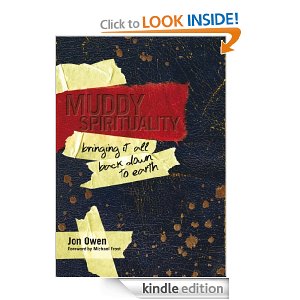
Jon Owen’s book, “Muddy Spirituality: Bringing it all back down to earth” tells the story of how one local Melbourne pastor collaborated with Hotham Mission to provide lodging for a group of asylum seekers:

“Aside form having to keep strong communication lines open, and with nearly daily cultural misunderstandings from a multi-national household, we also sought to make the house a home. When men live together the natural tendency is to shut off and make the place more like a boarding house, rather than a place where support can be found … it was a place where God was regularly sought, as we all learnt what it meant for people who were never meant to meet, to be forced by circumstances to live together. Regular common meals were the place where community was formed and relationships built”

They called it “The House of Hope” because they received people who have so few rights and so little protection, and they created a place where they received shelter, support and community. For the asylum seekers who stayed there and for those who oversaw the project, “The House of Hope” provided an opportunity to rediscover God’s compassion and the meaning of humanity.

“We got to meet many men from many nations and hear heart breaking stories of murder, torture and painful separation that left them scarred and traumatised”

See, all of us get to choose how we respond to the issue of refugees and asylum seekers. We can listen to the voices of fear and suspicion, and retreat into isolation and rejection. Or we can live in the values of mateship, a fair go, of justice, humility and peace that reveal the kingdom of God.

We can listen to the voices of fear and suspicion, and retreat into isolation and rejection. Or we can live in the values of mateship, a fair go, of justice, humility and peace that reveal the kingdom of God.

“Ministry begins with noticing the people who are all too easily overlooked. For those of us seeking to follow Jesus there are no invisible people. We need to pray that God provides us with the same eyes as Jesus. This vision begins when, instead of looking upwards, we look down at those who exist at our feet. The image of the Good Samaritan, getting off his donkey can truly become an icon for our transformation if we begin to allow the donkey of our culture’s hopes and dreams to stop driving us along the road, and we hop off for long enough, we will meet the people Jesus met.”
[Jon Owen, Muddy Spirituality]

On the night before one of the residents left to marry his fiancee, he spoke these moving words to everyone in the house, “thank you for helping awaken something within me what I thought was lost forever – the ability for my heart to once again love and trust, what I once lost has now been found, my heart thanks you.”

Read those words. Listen carefully, and you may be able to hear angels rejoicing…

Rethinking Refugees

IStock 000013899673XSmall

I have just had a vivid dream. And not being one who dreams a lot, I thought it was worth sharing.

I was at an outdoor venue listening to my daughter (@melodyjoyg) speak about Australia’s current treatment of refugees. Melody always speaks with passion and warmth, and this time was no exception. Except that I can’t remember anything she said. Toward the end, though, she said “I’ll now show you how we should welcome those who have risked all to come here…”

She asked us to close our eyes, and when we opened them Melody had transformed herself into a Old English Sheepdog puppy. I know. That’s pretty crazy. But think about it: what do you do with an old English Sheepdog Puppy? You walk up and pat it, cuddle it, play with it. You love a puppy like that, and you want to take it home, and make it part of your family.

So, how does all that work when we’re thinking about refugees?

Well, we all know that there are good processes to determine the bona fides of those seeking to be recognised as refugees, and we know Australia needs to guard her borders.

We should also know that over 90% of those who come to Australia in boats are eventually recognised as refugees. That is, nearly all have a valid case!

While not neglecting due process and assessment, my dream is that we can love and receive refugees warmly and openly and lovingly. As Australians, we need to learn how to ‘take them home and make them part of our family’. Like how we are drawn to embrace a puppy. We want to give them a home so we can care for them and provide shelter and safety. It may sound childish, and it probably should. Then again, children tell us a lot about how to treat people in need.

Yesterday I heard one voice that breathed a little light into the refugee question. Foreign Minister designate Bob Carr, almost as an aside in his press conference with the Prime Minister, said he was passionate about the plight of refugees. That’s what we need here: the language of heart, instead of the fear driven three word slogans of ‘Stop The Boats’.

Truth be known: Melody doesn’t work with refugees, although in her position with Compassion Australia, she has a great opportunity to bring the plight of the broken and the needy into our lives.

And really, I still think the whole sheepdog puppy thing is a little weird. But I know this: refugees need safety and care. They need love and friendship. They need to know there is a place where they can live without fear, where the nightmares can be stilled, and where they can breathe again.

Australia, we can do this.

Q: what are your thoughts about how we treat refugees?

Next: one inspiring example of how this has been done

Which Road Are You On?

Last weekend I attended ‘The Road Event’, a tremendously stimulating conference organized by Über, a Christian church in Melbourne Eastern suburbs.

The conference charted the development of cultural trends and ideas that have worked together to influence how we see life and how we view ourselves and our world. It all sounds a bit philosophical when you put it like that, but in actual fact is was down to earth, accessible, and incredibly insightful.

Much revolved around the use of the ‘story’ metaphor. The basic idea is that not only can your life be seen as a story, but that culture, too, is formed by one or a number of ‘stories’. Think of it this way: There is an overarching story or worldview that dominates our world. This ‘story’ may not be uniformly held or believed, and there might be different and competing stories. Even so, the influence of this ‘story’ is unmistakable.

There is an overarching story or worldview that dominates our world

Thinking about how ‘stories’ impact on our culture is much the same as thinking about the dominant world and life view around us. I don’t see too much difference between the different terms. What I do sense, though, is that the idea of a ‘story’ is a little easier for people to understand than the often philosophically overweight, jargon laden discussions about ‘world and life view’.

So what is the dominant ‘story’ in Australian culture? I can’t confess any real expertise, but it’s not hard to observe a few dominant themes:

• We have evolved from lesser life forms, there really is no God, we are a mass of carbon based atoms. Consequently the older ‘stories’ of faith, religion, and even traditional morality are irrelevant

• Consequently, there is no overarching ‘story’ to give life coherence and meaning. So the best way to live is to just be yourself and do no harm to others. Have as much fun doing this as you can, but don’t be surprised if you feel a yawning disconnect with everything.

• We have done terrible things in polluting our planet, so now we have to address them by reducing greenhouse gases and developing in sustainable industry

• All people should get a fair go, we should all have the same opportunities, and we should do what we can to help those who are disadvantaged

There are lots of others, but you get the drift. By ‘story’ we mean the major life views or world view that influences how we live. ‘The Road Event’ helped us see how we have been influenced by the culture of ‘the road’, an in this story where life has no ultimate destination all that matters is how we travel. All that matters is the journey. It sounds innocuous, but this view has influenced the church, Australian Christianity, social institutions, family life, our sense of self.

So my next posts are thoughts that flow on from this. I am indebted to the speakers at ‘The Road Event’: Mark Sayers, Andrew Shamy, Sarah Deutscher, and Tim Hein for their insightful critique, their warmhearted challenge, and their inspiring biblical vision.

Q: what ‘stories’ do you think dominate our culture? Leave a comment, and start a discussion!

Will God really protect me?

One of the primary questions people ask about Christianity is whether it produces actual outcomes: whether it makes a real difference to their lives. We know that Jesus is God’s son, that he died and rose again, that he rules the universe, and that he is returning to complete his restoration of all things. But does this make a difference to how we live?

This morning I read in Ps 94 how God is the avenger of those who are victimised and oppressed. He judges the earth. He does not reject his people or forsake his inheritance. He rises up for his people against his enemies. God is our fortress and our refuge.

Can you see how our view of God influences how we engage with our world and how we live in it and how we live with others? If God is our fortress, I don’t need to bolster myself with my status, or my possessions, or my reputation. If God is my refuge, I don’t have to take refuge in my orthodoxy, or in my church.

My comfort is that God’s plan will come to fruition irrespective of my circumstances

Today, my day is in God’s trusting hands. I move into my day knowing that I am working in his plan, so I don’t have to cajole him into working in mine. My comfort is that God’s plan will come to fruition irrespective of my circumstances. This is true for his plan for me, as well as his plans for my world.

Here’s the question we all need to ask: Do I actually believe God will protect me today? In my work, my living, my witness, my relationships, at my rock and my hard place?

Or are these things just nice thoughts to start the day with, but they have no ultimate power to impact my reality?

Following and Sacrifice

At first thought, following Jesus seems easy. It seems a matter of changing your mind about who Jesus is, recognising and accepting him as Saviour, and acknowledging him as King and Ruler. I suppose it is easy, relatively speaking, to see ‘following Jesus’ as a ‘decision’. Western Christianity often focuses on people making ‘decisions’ to follow Jesus, or to accept him as Saviour. In some places, these decisions are pretty much the only thing that matters. So, evangelism strategies and even services are focussed around getting people to make those decisions.

Many people who operate from an atheist or agnostic point of view will sometimes ‘the decision’ as the major battleground: with the focus being on the intellectual arguments as to why someone should follow Jesus, or whether there is a God, or an afterlife, or whatever. This makes some sense, because the primary battleground is the inner realities of human life: the heart, the mind, the will, the soul. People do need to assess who Jesus is with their mind, they do need to yield their will and bow before Jesus’ supreme and majestic authority. People do need to offer themselves – to give their heart – to this King as worshipful subjects.

Even so, if all I give is my inner realities, as significant as that may be, I don’t think I have begun to follow Jesus the way he intends me to follow. The inner realities are the starting point, sure, but those realities are connected to my behaviour and my attitudes. Here’s the rub: Jesus wants the change in your inner reality to come to concrete, consistent, continual expression in a changed life. Behaviour. Values. Attitudes. Talk. Generosity. Relationships. Business ethic. Lifestyle. Eating habits. Sexuality. Yep, pretty much everything.

This is why yesterday’s thought was so challenging: ‘think of those areas where you are not obeying Jesus, and start changing them now.’

See, friends, it is easy to ignore the call to changed behaviour and attitudes, and just concentrate on the ‘inner life’. We’re OK with change, as long as we can ‘spiritualise’ it, and restrict that change to comfortable areas like ‘growing in knowledge’, or ‘having a stronger faith’. Stressing ‘inner change’ while neglecting behaviour change is like paying attention to the safety features of your car, but still driving like a maniac. It makes no sense. It endangers to your life and the life of others. James the Apostle reminds us that the Devil has excellent knowledge of God, and that inner faith without outward expression is nothing but death.

So, God is calling you and me to change. Real change. Change that will be difficult. Jesus, in Luke 9, says that following him is like losing your life (9:24).

Are you up for that?

Are you prepared to change those things in your behaviour and in your attitudes that you know really do need to change? Are you prepared to put to death your love of wealth? Or your proclivity to gossip? Or your thirst for influence? Are you prepared to step into the compassionate lifestyle God calls you to have? Are you prepared to reduce your personal comfort to maximise your engagement with God’s mission? Are you committed to loving the people as an expression of the love for God in you?

Jesus gave his life for you on that terrible torturous cross. He counted his heavenly glory as nothing. But is following him actually costing you anything?

True. There are burdens that come as a consequence of truly following Jesus. They are felt when you start working out what God has worked in you (Philippians 2:12-13). And while it’s not a popular thing to say to comfortable western Christians, these burdens hurt and they chafe and they are weighty. This is what Jesus calls your cross (Luke 9:23).

You want to follow? Then take up your cross. Take it up daily. And, knowing he has called you, this cross, his cross on your shoulders, becomes easy, and light.

One last thing: Jesus never calls you to do this work on your own. Through his Spirit, he is present with you. He will give strength and endurance. He will give you all you need to follow, to change, to carry his cross.

So, about that change: what will it be for you? Make a commitment now: write it down, share your change with a friend, and ask them to keep you accountable.

Follow Me!

Reading Matthew 4 this morning I was again struck by how this very simple passage communicates such profound and (possibly) unnerving truths about Jesus.

Jesus shows up at the Sea of Galilee, and proceeds to call his first disciples. There is no promotional tour, no bus with a banner, no advertising campaign. Jesus just shows up, and says ‘Follow me”. Two words. Two little words. But they contain a universe of meaning.

Surprising

Jesus words are surprising in their simplicity. Simon, Andrew, James and John had no idea who this Jesus was. And we do not know what compelled them to leave their livelihoods, their trade, and follow. But they did. It is a surprising outcome.

Uncompromising

Jesus words are uncompromising. Very un-politically correct. There is no ‘please consider’ or ‘if you wouldn’t mind’ or even an ‘excuse me, but…’. They are a bold, bare imperative. A command. “Come, follow me”. Amazingly, the four men left their nets and followed him immediately.

All of us have behaviour and attitudes in our day to day lives which are destructive and which have to stop. Or things which are disobedient to God, which work against the world he desires. Or the sort of pure and simple indifference where we couldn’t give a toss. Jesus uncompromising call comes to us today and says, “follow me.”

George MacDonald, quoted in A Guide to Prayer for Ministers and Other Servants, says “It is simply absurd to say you believe, or even want to believe in him, if you do not do anything he tells you … but you can begin at once to be a disciple of the Living One, by obeying him in the first thing you can think of in which you are not obeying him. We must learn to obey him in everything, and so must begin somewhere.”

It is simply absurd to say you believe, or even want to believe in him, if you do not do anything he tells you

So: think of those areas where you are not obeying Jesus, and follow his uncompromising call. Why wait? Do it now.

Audacious

It’s an audacious claim, isn’t it? Whether it is Jesus’ words to the four followers, or his word to you, the implication is that Jesus’ rule over people is both universal and absolute. The audacity is that Jesus’ claim is presented as simply true. True, whether you accept this reality or not.

Jesus’ call to the four men, and their surprising and equally uncompromising decision to follow – and therefore obey – shows us not only that Jesus is true ruler. His claim also shows us that his rule starts in the hearts and lives of those who follow him. With people. Jesus’ followers are, in a sense, under new management. Jesus is directing their lives, and the impact is seen very clearly. In a sense, every follow says ‘Jesus is in charge, and this is what it looks like.’

Q: what would be the first things to change in your life if you were to follow Jesus and obey him in those areas where you currently are not obeying him?

PS. If you are intrigued by the phrase “Jesus is in charge, and this is what it looks like”, and you’d like to know more about Jesus (without all the religious clutter) I encourage you to get a copy of NT Wright’s new book, “Simply Jesus: A New Vision of Who He Was, What He Did, and Why He Matters” . Wright’s book opens our eyes to deeply scriptural emphases and to the life changing reality of Jesus. Koorong still notes the book as ‘not yet printed’ but you can definitely get it on line at Amazon and The Book Depository (and the latter does not charge freight!!). If you have a Kindle, iPad, or other eReader, you can access a copy right now.

I’m back…

I know, it’s been a while…

My last regular blog post was July 1. Since that time we have said many a tear filled good bye to great friends in Brisbane, moved to the other side of the country, started ministry at Gateway Community Church in Cockburn Central (Perth). I have buried my mother, and buried our crazy dog, Benson. And moved away from two children (Melody and Erin), still on the East Coast, and moved closer to our daughter Catherine, who with husband Dan are serving at Willetton CRC, also in Perth.

They say that some of the biggest stressors in life are: changing jobs, losing a loved one, or buying a house. We seemed to get all three together. Add to that how the circumstances of us leaving Redlands were not ideal (which is another story, to be told one day, but not yet) and it has been quite a time of upheaval for us.

As we were coming to terms with all that, there was too much going on to be seriously reflective. All that trauma kind of clouds your mental processes, and while you are grieving through it all you switch to more of a survival mode.

So, things have settled. We are in a beautiful Christian family. The Gateway people have embraced us and loved us and ministered to us in this time of change. Leonie and I are both really happy in our workplaces, and while loved ones and family on the East Coast seem half a world away, we are starting to feel like this is our place.

So this Christmas week I start to write again. As always, I will be thinking through elements of living as a follower of Jesus, and what it means to serve his mission at such a time as this. From time to time there will be some more personal posts. That’s OK – you cannot divorce your personhood from your calling, your ministry, or your faith. It’s all organically drawn together by God as he does his work in us and through us.

So, I just wanted to say that I am back. And my prayer today is that your Christmas Week might be full of blessing, and less busy than it has been. May your New Year cerebrations be full of thanksgiving, deep gratitude, and keen expectation of what the Lord will lead you into in the coming year.

Grace and peace,

Dave