Many will know how Pastoral Supervision provides a confidential context for support and restoration.
More recently, I have been encouraging supervisees to develop some “learning goals” to discuss and work through in their supervision sessions. These learning goals are identified and set by the supervisee. The supervision sessions can then focus on the supervisee working toward and implementing their goals.
We should note these goals are not ‘strategic’ in the normal sense of the word (achieve X or Y in their church – that’s the domain of coaching). These goals are personal to the supervisee, and typically relate to how they do their work and ministry. These ‘learning goals’ might explore
Contexts the supervisee might tend to avoid, with a view to working more effectively
How the supervisee might better listen effectively and attend to parishioner needs
How improve workload/time management and avoid ‘schedule creep’
How they can better work within, relate to, or lead their team
Pulling out of ‘autopilot’ and working more effectively on what matters most
Develop reflective practice, taking time to rest in the Word, and/or notice more how God might be working through their ministry
Learning Goals like the above show the formative function of Pastoral Supervision.
Goals like these can help a pastor bring better ministry and work toward better Gospel outcomes.
Now is the time to get your Supervision organised for 2026.
DM me with any questions and/or to make arrangements for 2026. Sessions can be arranged face to face or online.
People in ministry often say they don’t have time to unravel the complex pastoral issues that come their way. There are too many people to visit, too many meetings, there are sermons to plan, ministries to lead, contacts to follow up – and none of these fit neatly into organised blocks in the schedule … it never ends and it never seems to get better.
What tends to happen is that because we’re so time poor, when we sense there are complexities bearing down upon us, we’ll often push them out of our immediate awareness by just keeping busy and trying to get it all done.
The stress of all this will often work its way out in some other way: frayed nerves, short temper, irritability, a drink too many, other escapist behaviours …
This is why I love pastoral supervision.
Supervision provides a welcoming and courageous space where pastors can reflect on their work to learn how to do it differently and better.
Supervision is welcoming because it’s an intentional interruption to ministry’s constant demands. As I step into a supervision session, I have permission to pause, to breathe, to relax, and settle into a time of intentional reflection. I will meet with a friend (my supervisor) who comes beside me with an open heart, an accepting attitude, and a non judgemental spirit.
Supervision is courageous because I can wade into whatever is weighing me down as honestly as I can. I will be encouraged to see wider perspectives on the issues and on how I might move forward more effectively. My supervisor will encourage me to see what I really need to know, as opposed to what I merely want to hear. So supervision is a place for me to learn. I will be encouraged to own and address some of the harder lessons I might otherwise avoid. Supervision keeps me honest to myself and to my calling as a minister of the Gospel.
It’s no surprise that some of the most common feedback I receive is that supervision gives greater clarity on complex issues … it to find better ways to move ahead … it open up new perspectives on things that had been significant burdens.
That all sounds pretty positive – but here’s the thing: These are precisely the sort of conversations that pastors rarely have, and yet they are also precisely the sort of conversations they need to have. They bring such value to ministry and pastoral work. They help us bring our ministry practice closer to the theology and values we espouse. They can give new insights into how the Gospel is embodied in ministry – and that can be very transformational!
Where appropriate, I use a redemptive cycle of theological reflection. This method breaks down confusing or complex issues, allowing us to better hear how the Gospel of Jesus speaks to the situation at hand.
I’ll give some detail on the Redemptive Cycle in a future post – but for now, we can all imagine that where pastors can approach their ministry with greater clarity, more insightfully working through Gospel values, they’ll likely be less stressed and working more sustainably. That is a huge win!
Would you like to know more? Email me and we’ll discuss how to take it forward.
A few weeks ago I had the pleasure of preaching at the installation service of our new pastor. As I prepared for the service, I was reflecting on the tasks any local church pastor might do on a typical week…
…respond to emails, make pastoral calls, address church leadership matters, service planning, sermon prep, connecting with the community, supporting volunteers, keep abreast of what’s happening in the world, train leaders, facilitate discipleship, review ministry programs, meet with a few ministry leaders, Safe Church training, engage new members, connect with visitors, preach a cracker of a sermon, keep learning, keep growing, make sure you take your day off, be a model parent, have a great family, find regular time for prayer and Bible reading…
No doubt, there are a few things I’ve missed, and maybe it’s just me, but ministry seems to be getting more and more demanding. When I was in local church ministry, I found the best way to prepare for Sunday was to have a day and a half of largely uninterrupted time to complete the background exegetical work and to formulate my Sunday message. The problem was getting (and retaining!) that uninterrupted space! The phone keeps ringing. Emails keep arriving. Text messages keep lighting up the phone. And there’s the gloriously noisy Kid’s Ministry just a room or two away…
I’ve started to calling the ever expanding list of pastoral responsibilities ‘ministry creep’. No matter how well planned your schedule is, there are interruptions. No matter how clear your job description is, there are always other things that find their way into your task list. Murphy’s Law: the list of things you have to do always exceeds the time you have allocated to do them. We all know this.
Needless to say, fragmentation and challenges of time management are par for the ministry course. The pressure may not always be intense, but it is constant. It’s hardly surprising, then, that pastors often struggle to stay grounded and keep their head above the waters of schedule and interruption.
Today’s Australian pastor is a hemisphere and two millennia away from the NT Church. Even so, Paul encouraged his younger pastor friend, Timothy, “keep your head in all situations”, “watch your life and doctrine closely”, “train yourself to be godly” (2 Tim 4:5; 1 Tim 4:7, 15-16).
My question is:
How do I do this?
What regular process do I have to keep watch over myself?
How do I train myself to be godly?
And can I even do any of this effectively on my own?
This is where regular pastoral supervision is really important. No doubt, there’s great value in reflecting on your own – we all should do this (and here are some tips to get you started) – but I am never going to have the sort of objectivity I need to really keep myself honest, or to ask myself the hard questions, or even just to probe a bit and notice something that might stand out clearly to another person.
Supervision allows me to step outside of my schedule, to step back from pastoral busyness and ministry creep, and in the caring presence of another, keep watch over myself better. Supervision helps me consider how ministry is impacting my soul, to consider how I can do better in my role, and how I can better engage in my wider ministry context.
Supervision will not make ministry creep go away, but it will more than likely help you approach the demands of your ministry with greater clarity. It will help to take you deeper into your calling, and to be more intentional about the care you bring to the people God has given you.
Ultimately, supervision will bring you back to what matters most: doing ministry better, centring our ministry on honouring Jesus, nurturing his people to maturity, and stimulating his church to embody the Kingdom of God to his world.
When Supervision helps me sort through the clutter and approach my work with greater clarity, it makes sense to make it a priority.
Action steps:
Email me here to discuss how regular supervision can help your ministry.
Speak to your church leadership about making this a regular priority. If you’d like me to connect with your leadership I’d be open to exploring this.
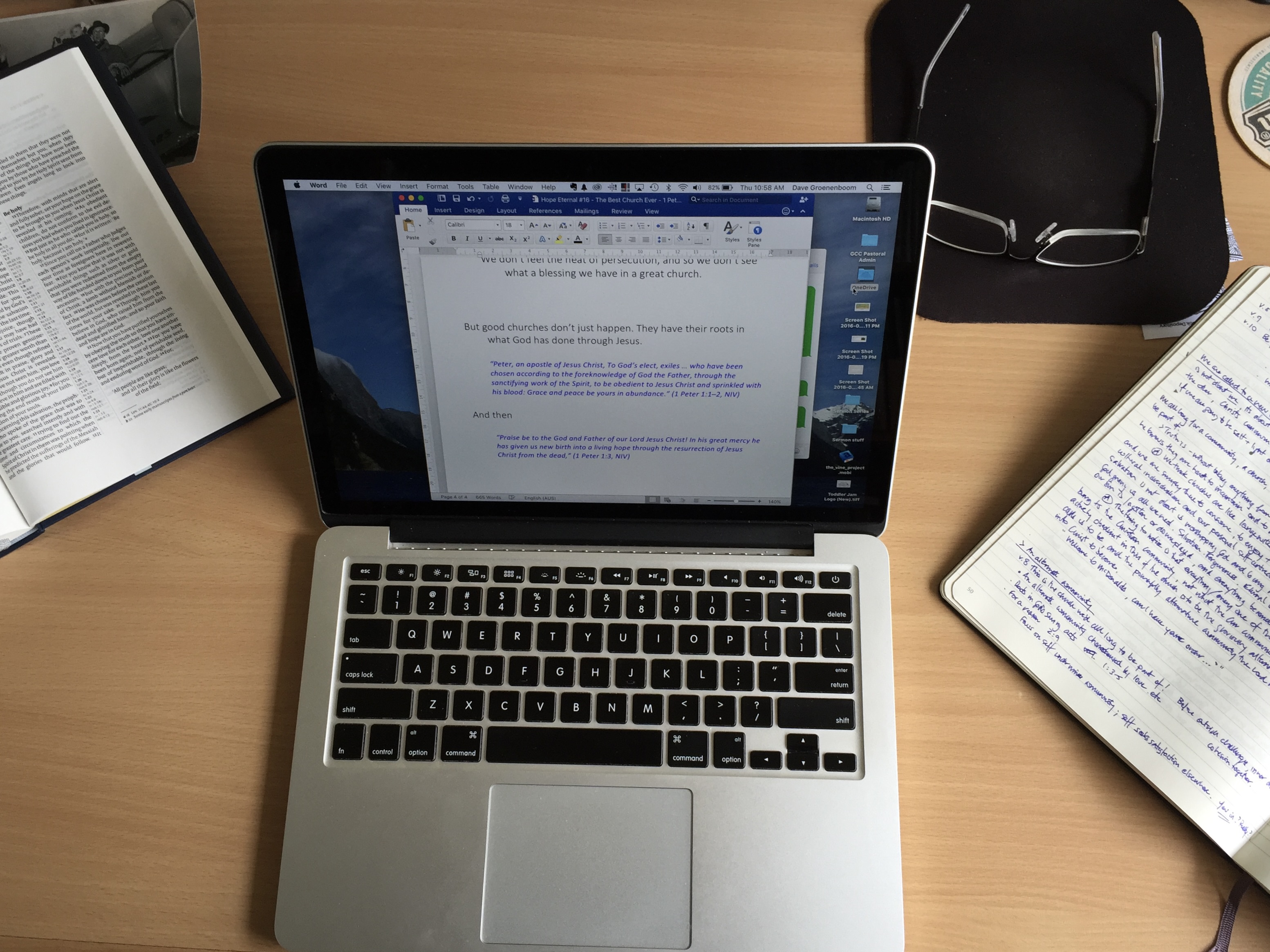
One of the best ways to understand pastoral supervision is to see it in the Biblical concept of “paraklesis”. We find the word group in the New Testament, amongst other things, to describe one person coming beside another to encourage and support them. Jesus used this word when talking to his disciples about the Holy Spirit, whom he would send to lead his people into all truth and be with them forever (see John 14:15ff, 15:26). The word is used to describe Barnabas the ‘son of encouragement’ (Acts 4:36). In Romans 15 Paul uses the word to refer to the endurance and encouragement that comes from Scripture and which brings hope. This is why in pastoral supervision a supervisor comes beside a minister to help them reflect on their ministry, and how they are engaging with that work, with a view to doing things differently in the future.
A safe and courageous space
Pastoral Supervision is a context of both safety and courage. It is ‘safe’ because supervision sessions are governed by strict confidentiality. Ministers and ministry workers can be assured that anything discussed will go no further (the only limitations here are when someone else is at risk, or reportable actions have been disclosed). Over my nearly 40 years in ministry, the best contexts I had to speak very candidly was when I was talking with someone acting as supervisor. Thankfully in my last two pastorates I was blessed with such people, and equally blessed that my local church supported those engagements in principle and financially. Sure, fellow leaders can be trusted too, but I found the supervisory context gave greater objectivity and freedom. In that sense supervision was particularly valuable.
Pastoral Supervision is not only safe, it is also courageous. It affords an opportunity to discuss one’s struggles, fears, joys and aspirations. It really is a blessing to be able to open up about the things that keep one awake at night, or the tendency to avoid certain situations/issues, or the weight of pastoral burdens, interactions with difficult people, even decisions one might struggle with in the local church or wider assemblies. Few ministers have contexts where they can courageously and with vulnerability engage in such self examination with a suitably qualified person.
While I recognise my knowledge of what other pastors are doing is not exhaustive, I think it’s fair to say throughout the recent history of the Australian evangelical church, our ability to engage in disciplined reflection about our calling and how we are going with it has not been a strong point. For too many, ministry experience has sometimes, perhaps often, been one of isolation, loneliness and helplessness. Supervision is a critical piece in changing that scenario.
If you have ever been asked for advice in situations of local church tension or ministry heartache you will probably have recognised the value of early intervention. You may also have observed that it did not eventuate, and that it was probably too late to retrieve the situation. Pastoral Supervision is no silver bullet to prevent such tragedies, but the anecdotal evidence indicates that good supervisory practice is a critical piece in reducing the incidence of pastoral breakdown.
It may be nineteen days late, but I’ve been on leave for the last three weeks, so this is the first chance I’ve had to express some thoughts and prayers I have been working through for the two months. I have called these ‘New Year’s Revolutions’, because most of them I just want to keep rolling around, returning, reforming and reframing with greater focus.
So here’s what I am looking at
I want a more prophetic and challenging ministry. That means I want to listen to what’s going on in my life, the lives of people around me, the culture in which I live, and hold that up to God’s call to be a people implementing and anticipating new creation. I want to speak to and expose our blind spots and the complacencies of my own culture. I want this to be decisive, incisive and breathed by the Spirit. Please understand: I do not want to suggest that we are all slacking off. The truth is, there are lots of people at RCRC who are great servants in great ministry. But we do have a tendency to favour what like and want, rather than true needs around us. I 2009 I would love to see that change
I want to see more spiritual passion. I could be wrong, but sometimes I sense that we’re wary about a rich expression of following Jesus in life and worship. Whether it’s a lavish gift, some outward expression of heartfelt joy, or a rich sense of community and acceptance when the community of Jesus followers gather. For this reason, I think it would be good to ask a few questions of ourselves:
Is my celebration of God as expressive as my celebration of great exam results or the victory of the team I love? Which one is better? Which gives me more hope?
Is my welcoming of Jesus followers on Sunday as warm, expressive and heartfelt as the meeting of a best friend I have not seen for a long time? Does our expression of community say something about the wonderful transformation Jesus has brought and is bringing?
Is God really the centre of my celebration on Sunday? How could I give better expression of this with his new community?
I want to lead and preach toward full commitment and Christ centeredness. We all know perfection only comes when Jesus returns so I’m not thinking of dividing us into business class Christians and the economy variety: some Christians who have ‘made it’ and others who haven’t. But let me ask you – and let me keep asking you:
Are you in top spiritual condition? Where do you rate yourself on a scale of 1-10 where 1 is ‘not at all Christ centred’, and 10 is ‘as Christ centred as I think I can be’. Let’s say you give yourself a 6/10. Do you think God is satisfied with that? If not, what do you have to do to move up a notch? What attitudes have to change? What do you need to put to death? What needs to come alive?
Is RCRC in top spiritual condition? What needs to change? What do we need to do more, and what should we be doing less?
Are you in a context where you are being stretched theologically? Where your desire to know God and serve him is really being deepened? Are you seeking greater opportunity to grow? Have you made a goal to nurture your faith significantly in 2009? Have you signed up for Foundations? (watch this space)
I want to see RCRC truly embrace a healthy outward focus. We’ve talked a lot about this: serving our community, being salt and light, being an agent of hope for Redlands. Now we have take it to the next level. I know we are all busy. Me too. I probably can’t do more things than what I am doing at present, so I need to think of the following:
What can I drop or do differently? Letting something go doesn’t mean I no longer agree with it, or that it’s become bad. It may just mean that as I change and meet new opportunities being a good steward means I need to do things differently
What will I do to specifically serve the outward mission of the church? Jesus has given his transforming love to me minute by minute – so how will I implement something of his transformation in my life? You may not be Mother Theresa, but here are 10 suggestions (as distinct from commandments) to start you on your way:
visit some lonely people
cook a meal for the single mum a few doors away
ring/email school chaplains to let them know I’m praying for them
send regular encouragement to those involved in RE teaching
support RCRC specifically engaged in evangelism ministry
just pray daily for my church to move from ‘in here’ to ‘out there’. Pray for Ministry Team people like Dan Neville, Geoff Hughes and Rod McWilliams as they seek to lead us into this
And then, a wish: I would love to see some healthy creative ministry develop, specifically for powerful communication at Sunday services. I am not talking about ‘skits’ so much, as well produced, well presented, dramatic presentations that support, add texture, and harmonise with what preachers like me present. These can be so powerful!
I wouldn’t mind betting that there are a few people in the RCRC family who could run with this – speak to me! What a great way to use your talents and gifts to bring God’s message of grace and hope to people!
Friends, I know this year will have its share of challenges. We all, by God’s grace, need to pull together and in the same direction. Ours is the rich privilege of taking the blessings God has so richly poured out on us, and using them to bless those who have no hope, or power, or love. God has blessed us with life in Jesus, and this year we get to celebrate it afresh with one another.
What we need to understand it that the purpose of that life and blessing is to carry it to the community around us, so that the world may know there is a God who is transforming His world through His Son, Jesus.



 Paraklesis