

Pastor, what do you do when you’re ’out of season’?

Pic: D Groenenboom

Preach the word; be prepared in season and out of season; correct, rebuke and encourage—with great patience and careful instruction.” (2 Timothy 4:2, NIV)

Reflecting on this passage this morning, I thought about that phrase “be prepared in season and out of season.”

In the original, ‘be prepared’ is a call to ‘stand up’ or ‘be ready’ to preach and minister under any circumstance. Lea and Griffin (NAC) see this as staying on task whether you feel like it or not, and/or whether the people under your care find it convenient or not.

I’m guessing most pastors sense when either they or their church is in season or out of season: times of self-doubt, fatigue, feelings of hopelessness and/or helplessness. Or church congregations which may need challenge, correction, or gentle guidance into the newness of the Kingdom (see 2 Tim 4:1).

It would be nice if all pastors found these situations easy to work out. It would be great to know they can pick themselves up in times of doubt, or tiredness, or the weariness of long obedience. Truth is, even if a pastor has sufficient mental clarity to make what they believe to be sound decisions at such times, few have the necessary objectivity and headspace to do so.

This is one of the reasons why plurality of leadership is a very good thing in the church. Besides being biblical, pastors can talk through challenging matters and prayerfully decide with their team what the best approach might be.

So, what does a pastor when they find themselves ‘out of season’? When things are not going well, when ministry – too often – interrupts life, well-being, and healthy practice?

Beyond any team discussion of pastoral challenges, the guided reflection of regular pastoral supervision can be incredibly helpful. Supervision sessions can bring new understanding to how one responds to ministry complexities, to one’s perceptions and perspectives. Pastoral Supervision provides a safe and confidential space to reflect on one’s work, how one is responding to ministry situations, and how one might do it better.

An ‘out of season’ moment…

Consider how Pastor John* dealt with his ‘out of season’ experience…

John’s interactions with Harry* were becoming complicated. It seemed that every time they spoke there was awkwardness and discomfort. John sensed that Harry was unhappy. Was it something John was doing? A direction the church was taking? Something about John himself? He just couldn’t work it out. John knew he had to do something, but it was all too confusing to think clearly about it all.

John, like most pastors, loved pastoral work and often took the role of peacemaker. He didn’t like it when people conveyed disapproval or unhappiness. John was especially uncomfortable because it had gotten back to him that Harry had spoken to others about his feelings. Would others turn against him too? What was Harry’s problem? What had John done wrong? What could he do about it? Could he do anything to change the situation?

An additional complication – not uncommon in church circles – was that Harry had strong connections with some of John’s co-leaders – that made any discussion of the issue quite tricky.

Sure enough, when John was trying to turn off at night, those questions yapped like a stray dog at the heels of his consciousness. So he was wide awake at a time when he could ill afford it. John was tired, confused, isolated and increasingly anxious.

John’s pastoral supervision experience…

John took his experience to his next supervision session. The supervisor sat with John, probing various perspectives, enabling John to fully explore and verbalise his experience. This helped John broaden his perspective and get some clarity on his core responsibilities. Supervision provided a safe space for John to consider what Harry’s point of view might be. Together John and his supervisor explored what Scripture might have to say to John, to Harry, and what impact the Gospel might have on it all.

Supervision helped John untangle his thoughts and responses. The Gospel truths John considered with his Supervisor were not new to him, but he did find some new ways to apply them to his complex situation. John’s Supervisor wasn’t telling John what he should do: he just helped him access his own theology and apply it to his pastoral interactions. In the sessions John was able to decide on a plan to move ahead and identified some specific ways he could interact with Harry.

Supervision helped John find clarity on his own responses and what he might be able to do differently. John felt safe to be vulnerable about himself, his fears, and his thoughts about Harry. He was able to review how things unfolded in subsequent supervision sessions.

The value of supervision

While a coach might have worked with John to identify better goals and strategies, and a mentor might have passed on some of their timely wisdom, John’s professional pastoral supervisor helped him see this issue with greater clarity. He guided John to identify how Scripture and theology informed the context, and drew it all together in a workable action plan to be reviewed in future sessions. 

Supervision is no silver bullet. The sessions can be hard work, but they allow a vulnerability, an objectivity and discernment that can lead to significant learning outcomes and better ministry. For both John and Harry, the Gospel might come to greater expression, and that would be good news all around.

*Not their real names

David Groenenboom
Repairing the Brokenness

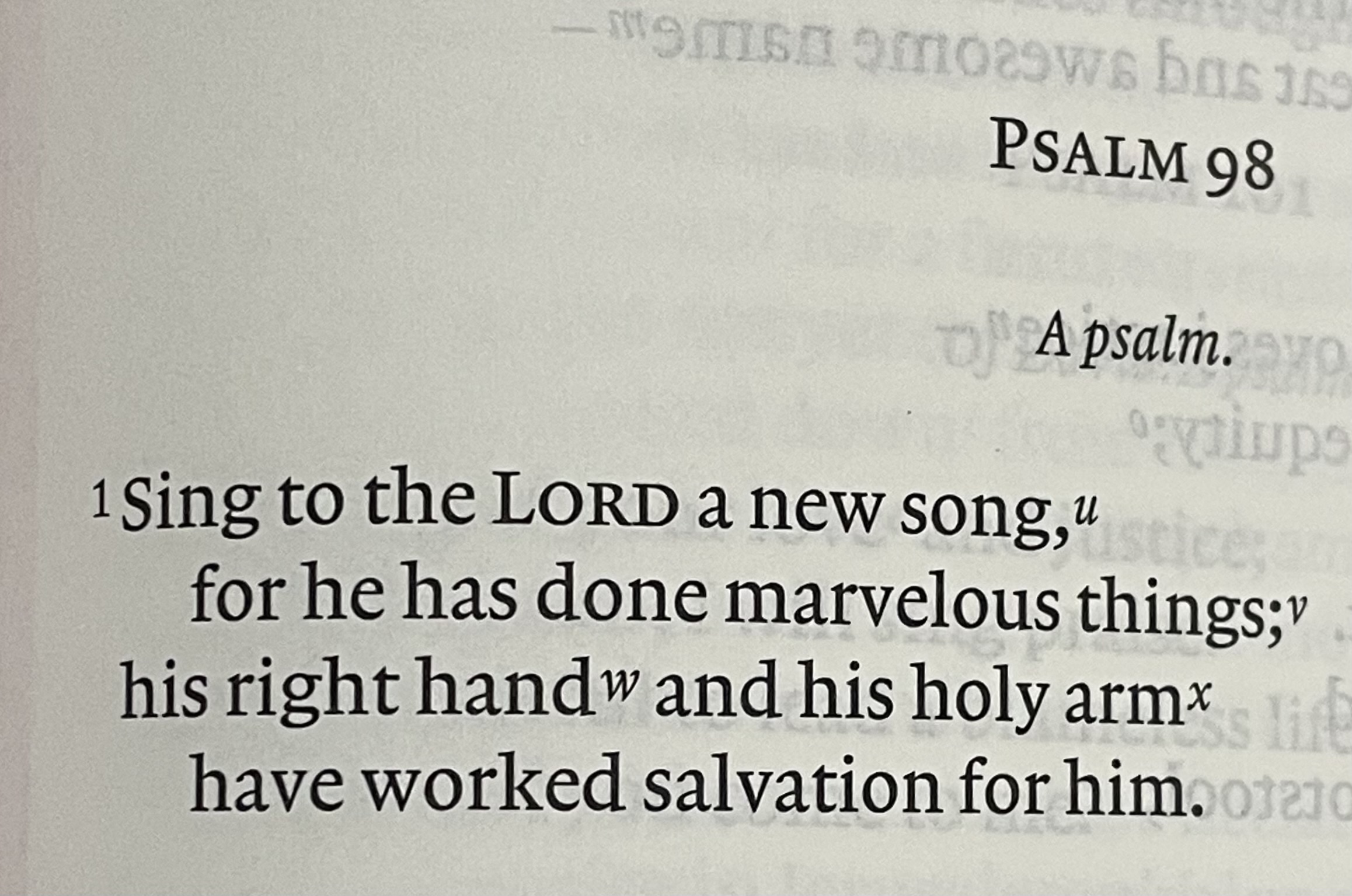
Psalm 98

This Psalm just overflows with jubilation! It voices the ‘new song’ of people who can see that the Lord is coming in righteousness! And they are thrilled to bits!

But that does that mean that God is coming in righteousness?

Well, in this instance it does not mean that he will come in the white hot rage of punishment and retribution where he will obliterate every force to ever stand against him. Yes, that Day will come – but that’s not why this Psalm is so jubilant.

When the Psalm rejoices that the Lord is coming on righteousness, it’s celebrating something else: the coming of the Lord into our world to do “marvellous things.” His “right hand” of power and his arm of holiness are bringing rescue and salvation (v.1).

The Lord has revealed his salvation – the nature of his rescue and its impact – by revealing his righteousness to the nations! So, all people who are not “Israel” will see how God, bringing rescue, puts their lives, their world, their everything, back together again! Amazing! Our God is a justice bringing, brokenness mending, life giving, sin defeating, shalom restoring God!

v.3 reminds us: this is not a new thing. It is the outworking of his covenant promises (eg. Gen 12). His “love and faithfulness” will go to the ends of the earth! This is his promise and his intention.

So it’s no wonder that all people, all nations, burst into rapturous praise (v.4-6)!

It’s no wonder that even the environment in its totality – all nature – rejoices! It’s the delightful opposite to the groaning of creation in Romans 8, because God – coming in righteousness – is addressing the brokenness brought by the fall. Our God is putting things right! He’s repairing what sin has broken! It’s glorious!!

All people and all creation joined in rejoicing in his goodness! All reality is in love with the righteousness and equity he is bringing. I mean, who wouldn’t be thrilled to see that?

But here’s the question you’re asking: How is God doing this? How is God bringing his righteousness today?

Here’s the surprising answer: God is doing it through Jesus, as Jesus rules in your life!

Jesus’ plan is for for God’s righteousness – which he has won for you in his cross and resurrection – Jesus’ plan is for that righteousness to overflow from your life into everything around you.

And what does that mean?

God’s righteousness – his ‘putting things right and mending the brokenness of our world’ starts as you put things right in your life. It comes through you bringing your behaviour and attitudes into line with the character and Kingdom of Jesus (see what the Bible says in Eph 4:17 – 5:2).

God’s righteousness comes to your world as you work, in the strength Jesus gives, to put broken things right around you. Your relationships. Your family. Your friends. The community where you live. Start putting right whatever is wrong. You: making things safe. Living in friendliness. Bringing grace and goodness. Creating a safe environment for women, for children, for those who are vulnerable and lonely.

God’s righteousness comes as you pray for and work to change desperate situations, and you long for grace in Gaza, as you work for an end to environmental degradation, as you act in kindness and respect to First Nations Peoples in your community.

God’s righteousness comes into our world as you work to bless and build your church, to see it thrive, to help it become a sanctuary of peace, a haven of love, against all the madness and anxiety that our culture and communities seem to carry.

God’s righteousness has been won by Jesus, and he’s bringing it to your world as you embody his character and goodness in your words, your attitudes and your behaviour!

How good is that?

Forgiveness is God’s Nature (5)

I have never been able to understand those who say that the God we read about in the Old Testament is angry and vindictive, while the God we read about in the New Testament is loving and kind. The reality is that God has always been gracious and forgiving, and this flows right out of the core of his being.

Think of the account of Moses on Mt Sinai in Exodus 34. Moses had asked to see the glory of The Lord, and God agrees to pass by and allow Moses to see ‘his back’. There is much in this passage that is hard to grasp, but one thing that is very clear is the nature and character of The Lord. As God passes by he proclaims his own name to Moses: “The Lord, The Lord, the compassionate and gracious God, slow to anger, abounding in love and faithfulness, maintaining love to thousands, and forgiving wickedness and sin, yet he does not leave the guilty unpunished; he punishes the children for the sin of the parents to the third and fourth generation.”

Sure, punishment is mentioned. But the thing to note is what receives the emphasis. The first things mentioned are compassion, grace, slowness to anger, love, faithfulness, more love, and forgiveness. This provides the backdrop for any words about punishment: if God is going to be compassionate and gracious and loving, then he must call to account those who are not compassionate, gracious and loving. But that’s another post…

The main thing to see is how close forgiveness is to the heart of God. Right at core of his character is his desire to forgive.

Forgive is an interesting word. The Hebrew word is nāśā. It means to lift, to carry, to take up, to lift off. So, right at the core of God’s heart is his deep inclination to lift off the burden that weighs people down. God desires to lift off the weight of sin and guilt. He does not want to see people bent and broken by wrongdoing and the fall.

It reminds me of John Bunyan’s Christian, who makes his journey with a ridiculously huge burden strapped to his back. That burden is his own sin. Christian can’t get rid of it, no matter what he tries to do. But here’s the deal: God can get rid of it. And if we pay attention to what God says is at the core of his being, it’s clear that he wants to lift that burden: he forgives wickedness and sin.

In case you wondered whether this desire to forgive was at the heart of God, we see the same thing said about the Servant of The Lord in Isaiah 53 “Surely he took up our pain and bore our suffering”. The ‘giveness’ of God is expressed in the giving of his Son, Jesus, who took up our pain and suffering, our transgressions and iniquities.

So these are core realities for God, for how he reveals himself, for how he sees himself, as well as the core mission of his son, Jesus Christ. God’s giveness is the foundation of his forgiveness. Our sin and guilt can be forgiven and forgotten because our wonderful God lifts it off us, and carries it away from us, in all he has done through Jesus his son.

When it comes to being forgiven, and being forgiving people, we have to start with the nature of God, with his core characteristics, and the clear reality of what he has done through Jesus. He is a deeply gracious God, and his desire is to forgive all your wrong and every sin.

Is this how you are used to thinking about God?

What does the fact that forgiveness is at the core of God’s heart mean to you?

Forgiveness is being honest with what happened (4)

Forgiveness is not only about being honest with people. It is also about being honest about what happened. We are not just blaming people, we are blaming them for what they have done. Smedes reminds us that talking about blame is risky. It sounds as if we’re laying all responsibility at the feet of the others and none at our own. But that’s not what it is about. When we talk blame, we are just saying that something has happened and someone has done it. We need to recognise that. Some of the blame may be laid at our own feet. We may have contributed to the situation, so we also need to be honest about our part in it all.

So something happened. Something was done. And people were hurt. If we want to do the work of forgiveness well, and if we want it to last, we need to name what has happened.

Was it something they said? An attitude expressed toward you, or someone close to you? Was it an act of passion? A crime? An assassination of character? Was it neglect, perhaps unintentional, but nonetheless hurtful? The more specific you can get, the more your work of forgiveness will benefit.

If we want to do the work of forgiveness well we need to name what has happened.

This is can be a little dangerous. Remembering what has been done can open the door to resentment and bitterness. Bitterness is a broad and easy road, and many are those who walk on it. It’s so easy to be nurse our pain. We turn it over, over and over again. But as we do, forgiveness and freedom move further away from us, and the poison of bitterness starts to work it’s way through our being until we are all but paralysed.

The other side of the coin is that sometimes our resistance to naming what happened stems from a fear of owning up to what we have done. At other times it is because the hurt is so deep, and what happened was so ugly that we are just happy not to have to talk about it. So, keeping it general and non specific is form of defence mechanism.

More often than not, what we are trying to protect ourselves from is our own guilt. Like a husband who has cheated on his wife might say ‘sorry for how it all ended up’. What does that really mean? Couldn’t his grieving wife say the same? Even their counsellor could say ‘sorry for how it all ended up.’ That’s a coward’s way to say sorry. That guy needs to be honest about what he has done. As long as he refuses to own up to his actions, his wife’s grief is trivialised, her pain is ignored, and his wrong still has his heart bound.

Being honest about what has happened makes good practical sense. More than that, God agrees. When Nathan the prophet confronted David about Bathsheba, he was more than angry about how it all ended up (2 Sam 12). When Jesus spoke with the woman at the well (John 4), his probing question made her uncomfortable, for sure. But if he hadn’t gone there, she would not have known the reality of her need. And without that, she would not have been able to revive the healing and restoration Jesus gave to her.

Because forgiveness has its root in God’s giveness, it is about giving something. We give someone who has hurt us a new start, we give ourselves a break, and – if we can talk about it like that – we give God an opportunity for his better way to come to expression. But we need to be honest: honest with people, and honest about what has happened.

In the next few posts, I want to look at some of the things the New Testament says about forgiveness. We’ll be working towards what actually happens when we forgive, and some of the consequences when we don’t.

Have you ever found it hard to get specific about what has happened? Was that because of something you had done, or because of something someone else did to you? Is there someone you need to talk to about this?

PS. Thanks for sharing this journey with me. Your comments are encouraging, and your questions are challenging. Keep it up!

Forgiveness is being honest with people

Forgiveness, by its very nature, always involves people. It is people who get hurt. It is people who do the hurting. Forgiveness is always relational.

There are some terrible things that have happened to people, but they don’t need to be forgiven. In January 2011 an intense storm cell hovered over the Queensland city of Toowoomba. On any other day, Toowoomba hardly has a creek to its name, but that day it flooded so badly that cars were washed down the main street. The waters rushed down the range, and obliterated several small towns in the valley below. Lives were lost and livelihoods were dashed. Who was to blame? Who did this? No one did it. It was no one’s fault. No one was to blame. As Lewis Smedes reminds us, if there’s no one to blame, there’s nothing to forgive (The Art of Forgiving, p.77).

Forgiveness is only relevant when others are involved. In some ways this makes sense. It may be easy to remember hurts that others have done to us. At other times, who those ‘others’ are will sometimes catch us off guard. We’re not always ready to admit that sometimes the hurt has come from our own actions. So sometimes we have to forgive ourselves. On other occasions, hurt comes from a group of people. Truth is, forgiving is always messy. And you can be sure the more people are involved, the messier it gets.

people are always in the mix

So, when it comes to forgiveness, people are always in the mix. Real people. Real lives. Real pain and real grief. It’s easy to lose sight of this, and it’s often convenient to avoid it. It’s easier, if we have hurt someone, to just think about ‘issues’ and ‘events’ and ‘what went wrong’. When we avoid the people in the equation, though, we dehumanise the pain. This is sin on three counts:

We sin against them, because we are not willing to see their hurt, or recognise our part in it.

We sin against ourselves: when we refuse to see the pain we have brought to others we deny ourselves the grace of being forgiven.

And we sin against God. It’s not just that he wants us to forgive. It’s more that his plan in Jesus is to raise us to a new life and a better way. God wants our lives, through Jesus, to express his better grace. He deeply wants his ‘giveness‘ to come to expression in our lives. Paul says as much when he writes “Be kind and compassionate to one another, forgiving each other, just as in Christ God forgave you. Follow God’s example, therefore, as dearly loved children, and walk in the way of love, just as Christ loved us and gave himself up for us as a fragrant offering and sacrifice to God.” (Eph 4:32ff)

We have to be honest about the impact of our actions on people, and their impact on us. If we fail to see the people in the equation, sin, wrongdoing, and guilt will have its way with us. And guilt is such a tireless tormentor.

Which is easier, to just focus on the issues, or to recognise the people involved and the pain they are going through? Which is better?

Familiarity and Fear

My reading this morning took me to several places: First Psalm 18 – a wonderful Psalm of God’s mighty protection, and his ability to bring victory to his people in battle. Then I read Ps 94, which spoke about the Lord’s justice to those who do evil.

I found myself wondering about our tendency to see God as a mate, to talk to him as if he is any other person in the room. As if.

God is to be feared, deeply respected, bowed before and submitted to. We don’t like this language – we think we’re better than that. Truth is, we aren’t. We are deeply flawed and woefully fallen people in need of repentance.

This creates a tension in our hearts that we would rather avoid and neglect.

My final reading took me to Heb 10:19-25. And this reading reminded me that the tension above is real: there is a yawning gulf between how God wants us to be and how we actually are.

Even so, the Cross of Jesus is also real. Because of Jesus we can

1) now enter the most holy place through his blood
2) we can draw near to God with full assurance because our hearts are cleansed, our guilt is removed, and our bodies are washed
3) encourage others to find their hope for forgiveness and in our living for his new world

God is awesome, and fearful, but Christ’s perfect love drives us out of fear and into the glorious saving presence of the living God.

How do you tend to see God – as one to be feared, or on the same level as anyone else in the room?

A Christmas Carol… with a difference

In early December, Redlands CRC had the privilege of leading some community carols in Wellington Point. Normally, this means setting up in the village green, providing a few singers and a spoken message, with the music being provided by the Redlands Brass Band. Councillor Wendy Boglary does a great job pulling the community together, and 2009 saw about 300 people attend the open air event.

This year was different. The weather was closing in, and storms threatened to turn the event into a wash out. Some quick thinking from Cr Boglary and the proprietor of Hogan’s Hotel in Wellington Point switched the event to inside the actual pub. It was a great gesture from Hogans, but it posed a problem for Cr Boglary: what would the people from the church think about having Carols in a place like a pub?

…what would people think about having Carols in a place like a pub?

Cr Boglary’s message on my phone had a tentative tone, as she wondered how I would react. Truth is: I thought it was a great idea. The Hotel patrons would be an instant crowd, and being indoors, it would be easier to hold everyone’s attention, not to mention the fact that if anyone got thirsty…

In the end: the venue change was a gift from God. As I spoke to the crowd that evening, I reminded them that when Jesus was born, it happened in the stable of an inn. These circumstances tell us that God came to everyday people, and that he did not wait for them to get their act together, or to become holy. Jesus’ birth tells us that God came to reconcile us to himself through his son.

God, himself, is missional. He sends himself into his rebellious world, enters people’s lives, meets them as and where they are, to bring those people back to him. This is missional grace par excellence.

This is not only an emphasis we see in the circumstances of Jesus’ birth. Jesus’ ministry and mission shows him going out to those on the fringe. Tax collectors. Sinners. Prostitutes. Foreigners. Outcasts. He did not wait for them to come to him. He went to them. They did not have to go to some religious place to ‘become holy’, rather as Jesus’ rule invaded their lives they expressed the holiness of his Kingdom. They we changed as they came under his rule.

I think this demands a rethink of typical outreach strategies today. Many strategies revolve around bringing people into the church: from ‘out there’ to ‘in here’. While event driven attractional mission is the strategy of choice for many today, it was not the strategy of choice in the New Testament.

It was a delightfully incarnational move.

So the carols were held in Hogans Hotel. It was a delightfully incarnational move. We connected with people who would not have met us in the village green, and most certainly would not have (and did not) meet at our Christmas Day service. Even so, it was a great night, the Gospel was spoken, the crowd were attentive, and they all loved it. It was a kingdom win.

The challenge for us is to perpetuate this outward movement, this move into the world. We need to find ways to undertake God’s mission today in a way that takes the Gospel to people and bring the Kingdom of Jesus into their lives.

Q: how do you think churches can enter their world with the good news of Jesus? Where would you start? How are you doing this at present? Please leave a comment and tell us.

Grace and peace: Dave

One small step for Mum & Dad, one huge step for love

Mum normally does not get going until about 8 or 8:30. Today, she was up well before that. Probably around 6:30am. When i asked why she was up so early, she said it was because something big was going to happen that day. And again I am reminded that Mum is fully aware of what this day will bring.


Mum & Dad, walking into Lovely Banks in Cobden

We’ve talked about that, my sisters and I. We’ve often wondered whether Mum really has a complete understanding of what is happening. I mean, how do you just move away from your husband of 57 years? How do you leave your family home? How do you just walk into a place like Lovely Banks, knowing it will be your last move before you die? How do you do any of that without breaking down, or worse, throwing a tantrum and digging your heels in?


Mum & Dad, December 19, 1953 married at the Leigh Memorial Church, Lithgow, NSW

I can think of two reasons. The first is that even though Mum is suffering her delusional fantasies, and she sometimes has trouble interpreting reality, she has enough of a handle on what’s going on to know that she needs this level of care. The second is that she knows Dad can’t be here carer anymore. Dad has chronic back pain, and so the lifting, the care, the pure and simple everyday being there was just getting the better of him. It was nothing for him to be up two or sometimes three times a night helping the disoriented love of his life to the toilet and back to bed again.


Settling in. The wonderful staff take Mum and Dad through some basics.

Dad told me tonight that this afternoon he has asked Mum, “You know why this was necessary, don’t you?” and Mum had said “Yes, because we couldn’t go on doing what we were doing anymore.” Some nights, Dad only had three hours of sleep. If even young guys have trouble coping with that, we can understand a 78 year old will never be able to manage it..

I think this says a lot about the love that Mum & Dad have for each other. Love is not doing what you want. If it was, Mum would still be home, irrespective of what harm it brought her and Dad. But that is not what love is. Love is a decision. Often and joyous one, but sometimes a painful one: to deny yourself, your wants, your comforts, and to consciously and selflessly do what the other person needs. So, as hard as it is, Mum decided that she had to make the move. That level of maturity, and that depth of love, is inspirational.

It’s a divine decision. It’s the sort of decision Jesus made, when he turned his back on his glory and made himself nothing for us. He denied his own wants and comforts, and instead he consciously and selflessly did what others needed.


Mum’s new room on Day 1

So we lie down in our beds tonight. Dad is alone in his room. Mum is alone in hers. And there is love. And there is peace. And we are thankful that God has led us through this day.

Have a read of Psalm 91. It’s brilliant!

Q: What do you think about love being defined as self denial and a decision to serve the other? is this actually doable? Leave a comment…

Grace and peace: Dave

Why great achievement inspires us to be better people

Last week we spent some time in Bath, Somerset. Best known for its Roman Baths, still operational after 2000 years, Bath boasts a rich architectural and social history.


Bath Abbey

Bath Abbey was founded in the 7th century, and rebuilt in the 12th and 16th centuries. Like most Abbeys and ancient churches, the Abbey presents a visual history of piety, fame and achievement.


Crypts line the floors while the walls covered with memorials to saints, gentry, and people of note. Sir Isaac Pittman, who invented shorthand notation. Captain Arthur Phillip, leader of the First Fleet, Governor of Australia also features in a memorial.


Memorial to Arthur Phillip

I do not know how many memorials there are in the Abbey. Probably hundreds. As I was walking through the Abbey, something occurred to me. Why do we have memorials? Why do we have this idea of achievement? Why do we honour achievement? And perhaps most importantly, why does achievement inspire us? It’s true: If we listen to our heart, we find ourselves drawn to those who make outstanding achievement. A roman architect in the first century AD. Thomas ‘Beau’ Nash (1674 – 1762) who in the 18th century, the town’s celebrated ‘dandy’, made substantial advances in breaking down some of the class divisions in Bath society, even if he di do it through some interesting means. Bishop Oliver King who undertook the building of the current Abbey in the early 1500s.


The organ in Bath Abbey, fanned arches in background

There is something in us that yearns to achieve. Every one of us. We want to do whatever we do very well. We want to excel, and develop, and pioneer, and create.

There is something in us that yearns to achieve. Every one of us. We want to do whatever we do very well. We want to excel, and develop, and pioneer, and create. Even we we do something very well, we still want to do better. It is in is to strive for perfection.

This desire is from God. The Genesis account tells us that God has placed his image in us. More: We are his image. And this means we want to do what God does. The early chapters of the Bible tells us that God wanted to create. And he did. He excelled. He caused life to abound. He caused the universe and humanity to thrive. It was all very good. It is not surprise that we find our purpose in imitating him.

We also know about rebellion and the Fall. While these are the natural inclination of our being, it’s not how this life giving, glorious achieving God first made us. In fact, Jesus’ coming is to draws us back to God’s original purpose. That’s why we imitate him, reflect his glory, and direct all our achievement to his wonderful praise.

Who has inspired you to be more than what you once were? What would to really long to do, or be?

Grace and peace: Dave

How to tell people about Jesus (3): …a few resources for answering the tough questions

In my last post I mentioned some books which I find helpful in addressing some of the common questions people ask. Here are a few titles to consider (feel free to recommend some others you have read in the comment section)

I may not need to say it, but there are no perfect books out there. You may not agree with everything an author says. That’s OK. People don’t agree with everything you say, either, and we need to relax about that. As always, test all things, and hang on to the good.

iStockphoto.com

The Case for Christ – Lee Strobel
Strobel recounts his own faith journey, and in so doing answers questions about the reliability of the New Testament, the historicity of the resurrection, and the person of Christ. Strobel’s background in law and journalism make this both a great resource and a well reasoned approach. It’s easy to read, and well priced to give away. Strobel writes as an ex-atheist, so you can be sure he knows where people are coming from.

The Case for Faith – Lee Strobel
In this book, Strobel builds on the foundation laid in his first work. He addresses some of the common the objections people may raise about believing in Jesus: the presence of evil and suffering; what about those who have never heard the good news? Or how do we explain the goodness of God in the face of the Bible’s teaching about Hell? Strobel opens up the issues of violence in church history. His section on the rarity and role of doubt in a believer’s life is especially helpful.

The Case for a Creator – Lee Strobel
Strobel addresses the perceived tension between science and faith, showing how many well respected scientists now see evidence of design in the universe and life systems. There is also a great DVD series which would be a great resource to work through in a small group setting.

Searching Issues – Nicky Gumbel
Nicky Gumbel is well known for the Alpha course. This book addresses the seven most common questions raised in Alpha course settings: suffering, other religions, sex before marriage, the New Age, homosexuality, science and Christianity, and the Trinity. There is also a helpful study guide for group work.

Simply Christian – NT Wright
A more inductive approach geared towards the thinking agnostic or atheist, while still very readable and accessible. Wright wants to get people thinking about what they see in their world and in the people who live in it. Staring with people’s longings, he looks at how the Bible presents God and the importance of Jesus, and finishes with what it means to be called followers of Jesus and to seek a world that God delights in. Reading this book brings memories of C S Lewis’ ‘Mere Christianity’. It’s a brilliant read!

Books like these can really help others to work through questions that trouble them. They will also help the reader become more effective as they share the message about Jesus.

Remember:

it is God who changes the heart, and not the power of an argument

. So read the best resources, and pray for God to use you

Q: Which book and resources have you found most helpful for sharing the good news? Leave a comment…

Grace and peace: Dave