
How to tell people about Jesus (they are probably more interested than you think)

Before we get to the best things to talk about to help people see who Jesus is, I’d like to explore the hesitation many feel about doing that.

It is no secret that many people find it hard to share the good news about Jesus. Here are some of the reasons I hear from time to time…

They imagine people are not interested. Generally speaking however, this is not true. People are quite tolerant, and open to talking about spiritual things. If you’ve already built a bit of a relationship with them, you’ll be able to talk about a lot of things, including your faith. It’s just not true that people don’t want to listen. What they don’t appreciate is an overbearing or judgmental attitude. Come to think of it, God doesn’t want that, either!

They think they need to know all the answers. It’s good to know some key responses to the common questions people ask. There are some great resources here: Understand, though, that most of the time you will not be able to explain everything. This is OK. Sometimes we just have to admit that we’re not really sure, and that we’re hoping to understand more sometime in the future. Here’s a few additional suggestions:

Ask them to explore the question with you: work on the answers together. This helps people see that you’re really not interested in cliched answers. It also helps them see that Christians are people who are prepared to apply their mind and their intellect to the troubling questions of life

Remember to take people back to the core issue of Jesus. If, for example, you are dealing with the question of why evil exists in a world governed by a good God, It’s fine to say something like ‘I have also wrestled with the question of the presence of evil in the world. I know Jesus came to break to domination of evil in people’s hearts. His promise is to bring it to right somehow, and sometimes that will involve us being prepared to engage in the fight against evil. But for me the big deal today is that I can trust God to do the right thing by me, and I can trust him to work the right things through me as I seek to follow him.’

A third reason people are hesitant to share about Jesus is because they are uncertain about the level of their own Bible knowledge. Having a good working bible knowledge is a great thing, but it will never be enough, really. There will always be things we don’t fully understand. So, just say so. People are more impressed with someone who says ‘I’m not sure’ than someone who has an answer for everything. People just want to engage at the level of the heart, at what matters to you, and why Jesus still matters to you. Sure, sometimes you will get to talk with a person who knows a bit about the Bible, and they may have some questions, but from my experience, these instances are pretty rare. Discussions that turn into arguments about Bible texts are rarely productive.

People are more impressed with someone who says ‘I’m not sure’ than someone who has an answer for everything.

Remember: you have the good news! You know who Jesus is! You have a hope that does not disappoint! That is an incredibly positive standpoint, and even though you think your life might be pretty ordinary, when you start talking about why Jesus makes a difference to you, most people will be interested enough to listen. More about this in my next post.

Q: what is your biggest fear or uncertainty about telling people the good news of Jesus? Or, what have you found helpful in addressing your hesitation?

Feel free to leave your answer as a comment…o

Grace and peace: Dave
The View

There’s a story that at the start of WWII, Australian military strategists were worried about the rapid advance of the Japanese Army. The Clarence River Wilderness Lodge’s Camp Kitchen has a photograph of some concrete tank traps that at one time were arranged across the Clarence River at Paddy’s Flat. The idea was that these concrete structures would halt the advance of the Japanese invaders. The story is that the Australian Forces believed the northern part of the continent was impossible to defend. So the claim was that the ‘Brisbane Line’ had been drawn from north of Brisbane, with the idea that everything above that line could be sacrificed to protect the south eastern population areas. Now I am not sure about the historicity of all that, but we wanted to see the tank traps, and we were told on good authority that they were still there.

Leonie, Erin, James and I hopped into the Subaru, with first stop in Urbenville (50 mins away), where Erin hoped to get some phone reception. By tethering my phone to my Vaio notebook, we would have internet on the road. Alas, Urbenville’s phone reception turned out to be pretty poor. Poorer than we needed it to be. So we thought the best idea was to drive along, while Leonie watched the phone’s reception indicator. The moment we would get three bars, we’d stop, connect the phone to the computer, and Erin could enrol in her Uni classes. We drove into a small place called Mulli Mulli, a small settlement of indigenous people, and all of a sudden we had five bars! We drove into a side street and pulled over. What was really interesting was that my PC found someone’s wireless service, and connected – so there we were thanking the people of Mulli Mulli for their hospitality!

Back in Urbenville, we visited Glad’s shop again to find out about the condition of some local roads. The shop assistant told us how you could get a great view of the surrounding area from a fire tower, about 15km down the road. So we drive the 7 km to North Yabbra Road, and another 7km to the track to the Fire Tower. The walk to the top was a steep and strenuous 20min climb. A steady and persistent pace seemed to be the trick. It occurred to me that the ascent to the fire tower stretched my cardio vascular system better than the stress test I had undertaken a few weeks before. I have never had any heart problems, and have never felt any reason for concern. Even when recently I found out that my heartbeat was a little irregular, I was relaxed about it, and subsequent tests showed there were no issues. As we walked up the mountain, with my heart rate at around 190, I started to wonder what would happen if I started having serious chest pain. There was no anxiety, or fear. Just a thought. It’s funny how in an instant, your thoughts can take you to the deep recesses of your soul. The thought pressed deeper: “Well, what would happen? What would you do?” It caught me off guard a little. So I let it play out. I imagined having to sit down, with Leonie, Erin and James gathering round. Someone would have run to the top of the hill with my phone, and call for an ambulance. The thought dug in deeper, and I reminded myself that whether the phone works or not, or whether the ambulance arrives on time are not the really big questions. I went deeper, and said, simply, “Dave, you are mortal. One day you are going to die.” Whether it was this day or another day, it was OK, because the life God has given me in Jesus is life that cannot be taken away. I was comforted to feel real peace about that. I was just happy to live the life God has given me in the here and now. And with this I pushed on.


How long did it take to think all that through? It is amazing how quickly it can happen. It might have been ten seconds, not much longer. Even so, a deep sense of peace and a more textured life perspective has come out of it. I think it has helped me feel more resolute, more settled, and more confident of God’s assurance of life. It has deepened and renewed my commitment to live heaven’s life in the here and now. To see and seek God’s goodness more in the land of the living.

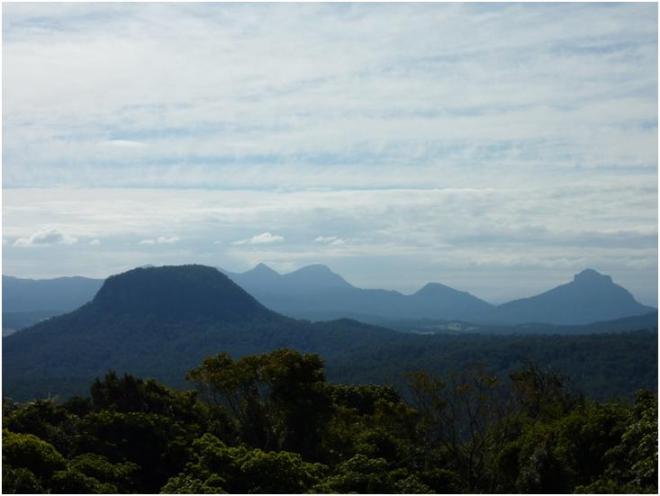
Arriving at the top was glorious (see pic, with Dome Mountain in the foreground, looking north toward Brisbane Ranges National Park), and all the more for the hard work of the walk. Climbing to the first level of the fire tower, we had a near 360° view across volcanic plugs like Dome Mountain and Edinburgh Castle, beyond Urbenville and Woodenbong, and to the southwest down along the valley toward Upper Tooloom.

Descending down the track to the car, we deflated the tyres to 24psi for a softer ride on the unsealed roads, and headed for Old Bonalbo, and 12km further, Bonalbo. I am not sure why one of these settlements is ‘old’ and one is not, but as you would expect, while Bonalbo was a larger town than its ‘older’ counterpart, it was still very small.

Bonalbo offered the best promise of a counter meal. We found the Dog ‘n’ Bull, and we were keenly aware that they had found us. The locals picked our car as being from out of town – the Qld licence plates a giveaway. It felt like all eyes we on us, and they probably were. This happens in country towns, but perhaps not to the same degree as it did in Bonalbo. We wondered about why this would be so. In the end we put it down to the Kingdom Hall a block away from the pub: perhaps people thought we were new JWs. We were quite sure all concerns evaporated when we entered the Dog ‘n’ Bull. We were pretty sure no Jehovah’s Witnesses would ever do that…

[more next time…]

Of the World, But Not In It?

I am writing a new sermon series (with Clinton) on the Sermon on the Mount. My first message is coming Sunday (Feb 07), and it comprises the whole Beatitudes passage – Matthew 5:1-12. “Blessed are the poor in spirit…”

I was reflecting about how Jesus calls his followers, broken as they are, to respond to the brokenness around them. One of the thoughts I had was that only a broken church can respond with blessing to the broken world they are in. This is how we reveal the kingdom of heaven, and show what it is really like.

Then I wondered about how does a church of reasonably comfortable suburban Christians start to enter into the brokenness in their community?

I was thinking we could email local MPs and local government people and ask them for guidance in where the greatest areas of need are. Then an uncomfortable realisation lodged itself in my mind, ‘why do I even need to do that? Why don’t I already know about brokenness in my own community? Why do we find it so hard to know what the greatest areas of need are? Why do we find it hard to see this?’

I think it’s because we get involved in our own lives, busy in our work, busy loving our families. We feel wronged when we don’t have any time to relax with our friends. Our churches are great, but there are so many things to do, so many programs, so many areas of ministry and service, that it’s just too easy to lose touch with the world around us. So we lose our connection with real people and their brokenness. We striving to get ahead financially, we want to make ends meet, become financially independent. We buy into the view that financial independence, comfortable living, owning the latest and greatest, brand-names-on-the-outside wardrobe, are the things that really matter. And as it turns out, we end up being of the world, but no longer in it.

Has the lifestyle of western suburban Christianity become a the new monasticism? Where Jesus’ people withdraw into their own virtual enclave and remove themselves form the world and its suffering? Is this why we do not perceive the brokenness around us?

A Million Miles in a Thousand Years – Don Miller


The story starts when a movie producer wants to make a film about Don Miller’s life. This is all very exciting until Don realises how boring it’s all going to look. So Don and the producers wrestle to develop a storyline that will hold interest. As they wrestle with this, we are drawn into what Don discovers, not only about movies, but about life itself. We start to see how life might work better, both for Don and for us. The surprise this book has for us is how this ‘better story’ might become our reality. 

A Million Miles in a Thousand Years drew me into the questions of my own life. I wondered about the ‘story’ or my own life, and before I knew it, I was thinking about how it could or should develop. As Don and the people of his book faced their challenges, I thought about how I was facing my own challenges, and whether I would meet them more resolutely, or further seek to avoid them.

I was also struck with the observation that the restlessness we sometimes feel in life often arises out of an ignorance of what our story actually is. Too often we do not know what sort of character we are supposed to be. As a consequence, we rarely get the idea that identity and meaning are formed as we grapple with the conflicts that inevitably come our way. Surprisingly, this realisation did not get me withdrawing from the challenge, it actually drew me deeper into it.

Miller’s book does that to you: it is an enticing invitation into hope. You read it and you want to be a better person. I love the way Miller’s warmth and spirituality sneaks up on you, whets your appetite for a fullness of life, and sometimes takes your breath away.


I have provided this review as a member of the Thomas nelson Book Review Blogger program. You can be part of it too by signing up at http://brb.thomasnelson.com/


Funerals: celebrating life

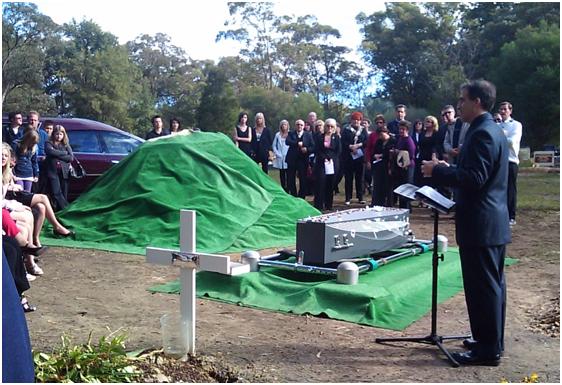
I have seen a lot of coffins, but I had never seen a coffin decorated with piano keys and music notes. Handles for the pall bearers were chrome cylinders attached with piano strings. I liked it. A lot. It was a tasteful expression of Eric’s love for music. While no professional musician, guests spoke of how he listened to, and drank in, and played music on a daily basis.

Before the casket was lowered, instead of throwing in soil, or laying a flower on the casket, people chose a piece of chocolate from a bowl, and placed it on top. I very deliberately placed by piece on B-flat. I don’t know that Eric was so into blues, but it suited my mood on the day.

Later, at the service of celebration, there was a tasteful mix of grief and laughter. Some of Eric’s children spoke, some performed musical pieces, his pastors spoke, guests spoke (more about that tomorrow), and once again, profound hope was expressed in music and song.

I have also seen funeral celebrations turn into a form of crass denial. Where it’s all made out to be a party, where banal humour and christo-pagan superstition permeates proceedings. “Yeah, I bet Bob’s up there now, beer in hand, looking at us all down here, wondering what all the fuss is about and when we’re all gonna get back to work…”

We can all do without that. And really, funerals do more harm than good when they trivialise life like that.

At Eric’s funeral we wrestled with life and its wending course. Together we sought to make sense of Jesus’ claim to be resurrection and life. We did that through our tears. And we celebrated everything Eric had brought into our lives, the talents he used to serve others, the expertise he brought to his workplace, and his quirky style of humour, we were celebrating the work of an extraordinary God in the life of an ordinary man.

But celebration? Seriously? How can you walk out of a funeral more in the lightness of hope than the heaviness of grief? This is the reality of Jesus’ life in us. His is a promise of hope, of life, that cannot be extinguished by death. This is what we have in the good news. When that deep celebration and profound joy resonates, even from a grieving community of followers, resurrection joy is palpable.

This is what we should celebrate at a funeral. How we have seen God’s life come to expression in this person. How we have seen beauty. How we have sensed a pursuit of justice and right. How they showed us a healthy spirituality. How we have learned about relationship, how others have been valued, honoured, and served.

Memories like anchor our affirmation in God’s work of grace in the life of another. We’re reminded that the Gospel is not just a religious idea or a doctrine to be intellectually accepted. It is an invigorating, transforming reality. When these transformational realities take root n a person’s life, they anticipate the new world Jesus will bring: God has already started his work of transformation in his people. Proof positive that Jesus is renewing minds, attitudes and values, and through them bringing change to his world. One life at a time.

Shalom,

Dave