So hard to watch: coming to terms with your own limitations

Today was not the best day. It turns out that Mum did not sleep too well. To be expected, really. It was her first night in Lovely Banks. The bed will be different. She will wake up to different surroundings. She will wake up tired. And all of that will compound to add to her confusion.


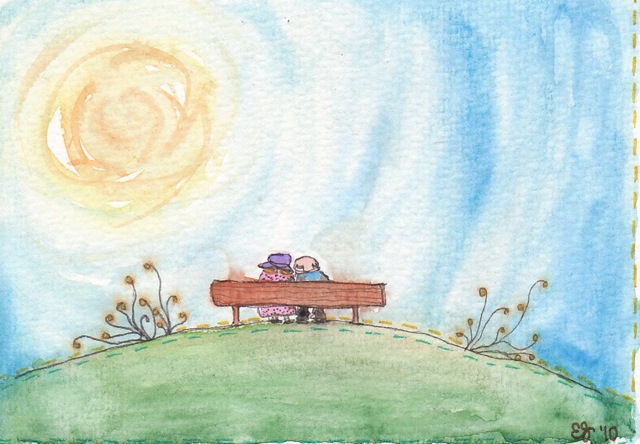
Old man and woman on a bench watching the sunset, watercolour by Erin Groenenboom

Dad and I visited at about 10:00am, and briefly spoke of our plans for the day. We would travel to Warrnambool, organise a phone, and maybe look at a few things Dad needed, and then make our way back to Cobden. Then there was a lamb roast to be cooked, and I was goIng to season and bake the potatoes and pumpkin.

We made the trip to Warrnambool, and finally made it back to see mum at about 3:30pm. By that time, however, it was clear her disrupted night’s sleep was taking it’s toll. She was rambling a little, and confusing her feeling
ill at lunchtime with having to go for a long walk away from home and thinking she was going to ‘croak’.

I made it back a second time to find that Mum was even more confused by that time. We watched as Mum rang the buzzer to go to the toilet. The carers came, lifted Mum to her feet, and took her to the toilet. Jo remarked “up to yesterday, we would have been doing that, or Dad would have been doing that, and I’m so glad we don’t have to anymore.” It’s not that we couldn’t be bothered, or that we felt the task was beneath us. I think Jo captured it when she put it in terms of being broken.

Love always has a cost. And for Dad and Jo, the cost was knowing that they had reached the limit of what they could do. The cost was realising that loving Mum meant they had to provide a level of care that they could no longer deliver. We struggled to accept the limits of our own love.

We struggled to answer Mum when she asked why she could not go with us, why we could not help her up, and why Jo and I were the only ones who were ‘allowed out’. We bit our lip as Mum came to terms with her reality as best she could…

“Can we get out? Can we leave now? Are you and Jo the only ones who can leave? Do I have to stay here by myself, then? On my own?”

“Yes Mum, you need to stay here, and Jo and I have to go. We have to be home by seven. The nurses will come and help you get changed. No, Mum, we cannot do that, they do, that’s what they are here for…”

In that moment, I remembered that as a young father, I occasionally had to leave our second youngest, Melody, at day care. She would be crying, “Daddy! Daddy! Daddy!”, pleading for me not to walk away. But I did. I walked away and left her in day care. It was about the hardest thing I had to do.

…we just have to walk away. We have to go, and now

This afternoon I remembered that experience. When Mum was questioning why we could leave, and why she couldn’t. I made eye contact with Jo and mouthed the words, “we just have to walk away. We have to go, and now.” I knew the longer we stayed, the harder it would be to leave. So we kissed Mum on the forehead, and said we’d we there tomorrow. And then we walked away.

Grace and peace: Dave

One small step for Mum & Dad, one huge step for love

Mum normally does not get going until about 8 or 8:30. Today, she was up well before that. Probably around 6:30am. When i asked why she was up so early, she said it was because something big was going to happen that day. And again I am reminded that Mum is fully aware of what this day will bring.


Mum & Dad, walking into Lovely Banks in Cobden

We’ve talked about that, my sisters and I. We’ve often wondered whether Mum really has a complete understanding of what is happening. I mean, how do you just move away from your husband of 57 years? How do you leave your family home? How do you just walk into a place like Lovely Banks, knowing it will be your last move before you die? How do you do any of that without breaking down, or worse, throwing a tantrum and digging your heels in?


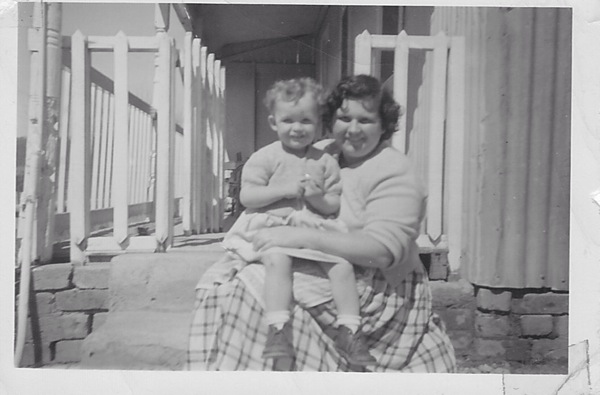
Mum & Dad, December 19, 1953 married at the Leigh Memorial Church, Lithgow, NSW

I can think of two reasons. The first is that even though Mum is suffering her delusional fantasies, and she sometimes has trouble interpreting reality, she has enough of a handle on what’s going on to know that she needs this level of care. The second is that she knows Dad can’t be here carer anymore. Dad has chronic back pain, and so the lifting, the care, the pure and simple everyday being there was just getting the better of him. It was nothing for him to be up two or sometimes three times a night helping the disoriented love of his life to the toilet and back to bed again.


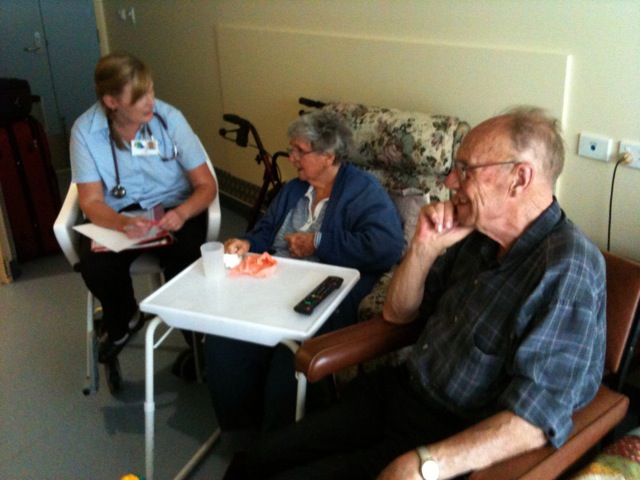
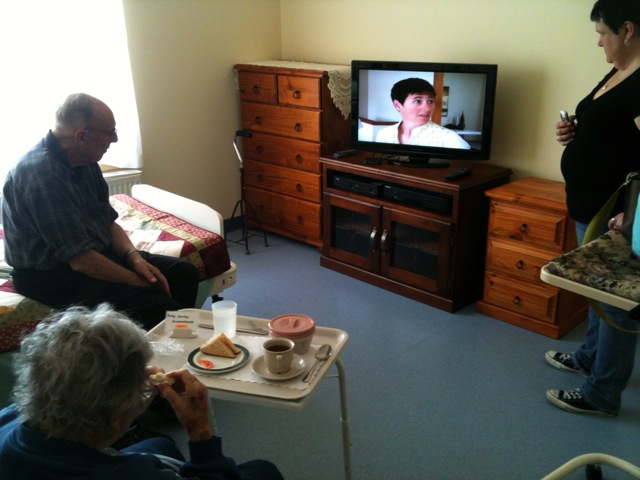
Settling in. The wonderful staff take Mum and Dad through some basics.

Dad told me tonight that this afternoon he has asked Mum, “You know why this was necessary, don’t you?” and Mum had said “Yes, because we couldn’t go on doing what we were doing anymore.” Some nights, Dad only had three hours of sleep. If even young guys have trouble coping with that, we can understand a 78 year old will never be able to manage it..

I think this says a lot about the love that Mum & Dad have for each other. Love is not doing what you want. If it was, Mum would still be home, irrespective of what harm it brought her and Dad. But that is not what love is. Love is a decision. Often and joyous one, but sometimes a painful one: to deny yourself, your wants, your comforts, and to consciously and selflessly do what the other person needs. So, as hard as it is, Mum decided that she had to make the move. That level of maturity, and that depth of love, is inspirational.

It’s a divine decision. It’s the sort of decision Jesus made, when he turned his back on his glory and made himself nothing for us. He denied his own wants and comforts, and instead he consciously and selflessly did what others needed.


Mum’s new room on Day 1

So we lie down in our beds tonight. Dad is alone in his room. Mum is alone in hers. And there is love. And there is peace. And we are thankful that God has led us through this day.

Have a read of Psalm 91. It’s brilliant!

Q: What do you think about love being defined as self denial and a decision to serve the other? is this actually doable? Leave a comment…

Grace and peace: Dave

Moving Mum

Want to know what it’s like to check your Mum into full care? I don’t know either, but one thing’s for sure: I am about to find out…

I am on a flight from Brisbane to Melbourne. This will be followed by a two and half hour drive to Victoria’s western district. Tonight I will stay at my parents’ home. It will be the last night Mum and Dad will spend together in their family home. I don’t think the momentous nature of this change has settled on us just yet.


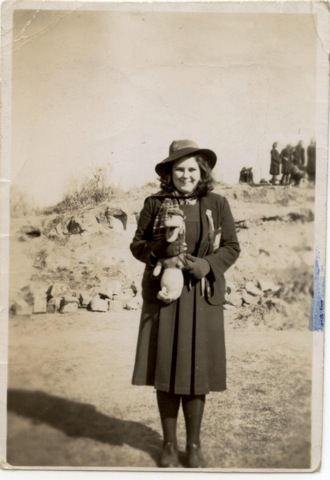
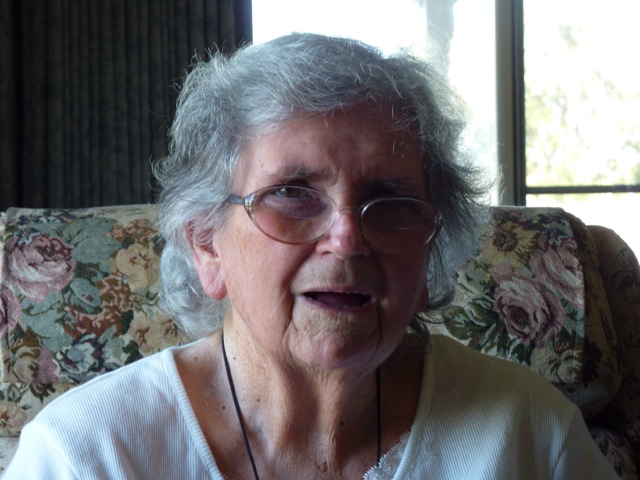
Mum, March 2010

So, it all started about three months ago. I was visiting Mum and Dad on one of my ‘flying visits’: quick mid week jaunts where I would stay over with them for two nights and then return home. Mum, Dad and I were to go next door to have tea with my sister Jo and her husband Fred. Jo was picking up some tea on the way home from work. So here we are, waiting in my parent’s lounge room, and Mum simply said “Do you think Jo will have enough food for all these people?” The phrase “all these people” took me by surprise: there were only the three of us in the room, and with Jo and Fred, that still only came to five.

“What do you mean, ‘all these people, Mum?’ There are only three of us, and then Jo and Fred” I said.

Mum gave me a bit of an odd look. Like she knew I was right, but also that there was some other reality invading hers…

I don’t think the momentous nature of this change has settled on us just yet.

Chatting with Jo later that night I learned that these ‘visions’ had been happening from time to time.

Then, two weeks later, I called Mum to see how she and Dad were going. Mum asked me whether I had heard what had happened earlier that morning. I hadn’t. So she told me: mum explained how that morning she had fainted, and she thought she had died, and that some people revived her, but now everything was OK. Or so her story went.

Since that time there have been a good number of other stories, all with a similar cast of other people. For some reason, they all seem to be dressed in black. We have come to call these people ‘the men in black’. These apparently benign and everpresent figures are very real to Mum. The problem is they are not real to anyone else who might be present at the time…

At this point, we have learned not to challenge the existence of the Men in Black, or anything else that Mum may “see”. Instead, we have decided to explore Mum’s experiences with her. We ask her what the Men in Black are doing, or what they are saying. I think this has helped ‘normalise’ Mum’s experiences for her, and I’m sure that if we challenged her every time she mentioned them, she would only become distressed. So our goal has been to keep things as normal as we can for Mum. It seems, at this point, to have been a successful strategy.

In the last three months Mum’s delusional ‘realities’ have made their presence felt in our lives. While we are still waiting for an official diagnosis, it seems that Mum is being drawn into the world of some sort of Alzheimer’s or dementia. In way, the diagnosis is kind of academic. Whatever it turns out to be, the ACAT clinician says Mum should go into full care, and hence this plane trip. And this blog post. And the ones that will follow.

In the next few posts I want to explore this time of transition for our family, in the hope that it may be helpful for others in the same position. And, of course, I’ll keep you up to date with how it all goes.

Q: Have you ever had to check a parent or loved one into full care? How did it go? Feel free to share your experiences by posting a comment.

Grace and peace: Dave

Why great achievement inspires us to be better people

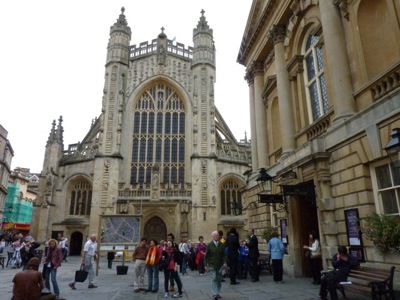
Last week we spent some time in Bath, Somerset. Best known for its Roman Baths, still operational after 2000 years, Bath boasts a rich architectural and social history.


Bath Abbey

Bath Abbey was founded in the 7th century, and rebuilt in the 12th and 16th centuries. Like most Abbeys and ancient churches, the Abbey presents a visual history of piety, fame and achievement.


Crypts line the floors while the walls covered with memorials to saints, gentry, and people of note. Sir Isaac Pittman, who invented shorthand notation. Captain Arthur Phillip, leader of the First Fleet, Governor of Australia also features in a memorial.


Memorial to Arthur Phillip

I do not know how many memorials there are in the Abbey. Probably hundreds. As I was walking through the Abbey, something occurred to me. Why do we have memorials? Why do we have this idea of achievement? Why do we honour achievement? And perhaps most importantly, why does achievement inspire us? It’s true: If we listen to our heart, we find ourselves drawn to those who make outstanding achievement. A roman architect in the first century AD. Thomas ‘Beau’ Nash (1674 – 1762) who in the 18th century, the town’s celebrated ‘dandy’, made substantial advances in breaking down some of the class divisions in Bath society, even if he di do it through some interesting means. Bishop Oliver King who undertook the building of the current Abbey in the early 1500s.


The organ in Bath Abbey, fanned arches in background

There is something in us that yearns to achieve. Every one of us. We want to do whatever we do very well. We want to excel, and develop, and pioneer, and create.

There is something in us that yearns to achieve. Every one of us. We want to do whatever we do very well. We want to excel, and develop, and pioneer, and create. Even we we do something very well, we still want to do better. It is in is to strive for perfection.

This desire is from God. The Genesis account tells us that God has placed his image in us. More: We are his image. And this means we want to do what God does. The early chapters of the Bible tells us that God wanted to create. And he did. He excelled. He caused life to abound. He caused the universe and humanity to thrive. It was all very good. It is not surprise that we find our purpose in imitating him.

We also know about rebellion and the Fall. While these are the natural inclination of our being, it’s not how this life giving, glorious achieving God first made us. In fact, Jesus’ coming is to draws us back to God’s original purpose. That’s why we imitate him, reflect his glory, and direct all our achievement to his wonderful praise.

Who has inspired you to be more than what you once were? What would to really long to do, or be?

Grace and peace: Dave

Under England Skies: Cornwall & Penzance

In England…

As we start our chronicle of our visit to the UK, first few posts will be a little brief. Since our arrival in arrival in England on Sunday Leonie and have been struggling to get over a stomach bug. Without going through all the details, today might be my first chance to eat something normal. Leonie has recovered a little quicker than me, but with the help of the kind people at Solihull Hospital. Our illness meant we had to cancel our first day’s plans, which included Salisbury Cathedral. Even so, we were able to finally get on the road on Tuesday, heading down toward the south west.

Heading toward Cornwall, our first stop was Taunton. We just pulled off the motorway to stop for a while, and we came across this delightful town, complete with a 12th Century castle.


Unfortunately the castle was closed for some renovations, so we were unable the take a tour. I did enjoy a true Cornish Pastie, and after all our dramas it did seem to sit well.

Penzance and Mousehole

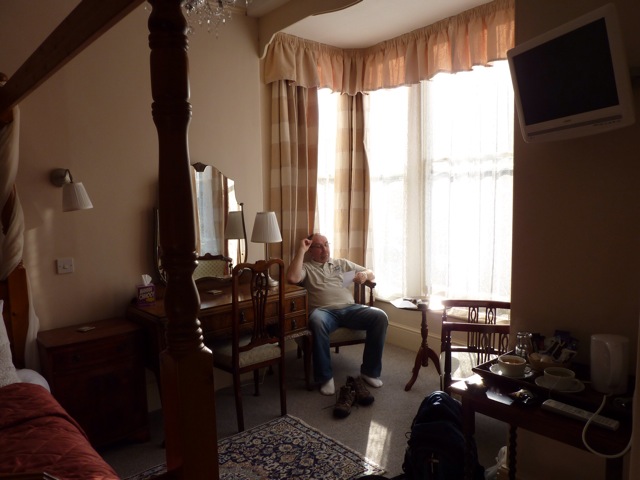
Penzance was our overnight. A cute little B&B called Glencree House. Lonely Planet had described Glencree as ‘budget’ and ‘a bit dated’. That review is a little harsh. Our very roomy apartment was amazing.


Our room in Glencree House

Full of what Aussies would call ‘antiques’ (the British call these ‘old furniture’). Lindsay and Andrew make fantastic hosts, and Andrew proved a gold mine of local knowledge for the Lands End and Penzance area.


View from our room in Glencree House

We enjoyed a light meal at The Drop Inn, but not all things were good with Dave’s stomach yet. So his next day’s rations consisted of a few spoons of yoghurt, a few berries, some crackers, and a white bun. And a whole lot of Lucozade. Mealwise, it has been a cheap gig thus far.

Just beyond Penzance is a tiny village called Mousehole (pronounced Moushul). This proved to be our introduction to English villages created well before the advent of automobiles. Tiny, windy streets. Stone cottages. Flower boxes. Cobblestones.


Mousehole harbour consists of a twin arc of stone walls with a tiny entrance for the small boats. The weather when we visited was very pleasant, but looking at the walls, and that tiny harbour, you just knew the Atlantic Ocean wasn’t always that way.

Grace and peace: Dave

Location:Abbey Green,Bath,United Kingdom

How to tell people about Jesus (3): …a few resources for answering the tough questions

In my last post I mentioned some books which I find helpful in addressing some of the common questions people ask. Here are a few titles to consider (feel free to recommend some others you have read in the comment section)

I may not need to say it, but there are no perfect books out there. You may not agree with everything an author says. That’s OK. People don’t agree with everything you say, either, and we need to relax about that. As always, test all things, and hang on to the good.

iStockphoto.com

The Case for Christ – Lee Strobel
Strobel recounts his own faith journey, and in so doing answers questions about the reliability of the New Testament, the historicity of the resurrection, and the person of Christ. Strobel’s background in law and journalism make this both a great resource and a well reasoned approach. It’s easy to read, and well priced to give away. Strobel writes as an ex-atheist, so you can be sure he knows where people are coming from.

The Case for Faith – Lee Strobel
In this book, Strobel builds on the foundation laid in his first work. He addresses some of the common the objections people may raise about believing in Jesus: the presence of evil and suffering; what about those who have never heard the good news? Or how do we explain the goodness of God in the face of the Bible’s teaching about Hell? Strobel opens up the issues of violence in church history. His section on the rarity and role of doubt in a believer’s life is especially helpful.

The Case for a Creator – Lee Strobel
Strobel addresses the perceived tension between science and faith, showing how many well respected scientists now see evidence of design in the universe and life systems. There is also a great DVD series which would be a great resource to work through in a small group setting.

Searching Issues – Nicky Gumbel
Nicky Gumbel is well known for the Alpha course. This book addresses the seven most common questions raised in Alpha course settings: suffering, other religions, sex before marriage, the New Age, homosexuality, science and Christianity, and the Trinity. There is also a helpful study guide for group work.

Simply Christian – NT Wright
A more inductive approach geared towards the thinking agnostic or atheist, while still very readable and accessible. Wright wants to get people thinking about what they see in their world and in the people who live in it. Staring with people’s longings, he looks at how the Bible presents God and the importance of Jesus, and finishes with what it means to be called followers of Jesus and to seek a world that God delights in. Reading this book brings memories of C S Lewis’ ‘Mere Christianity’. It’s a brilliant read!

Books like these can really help others to work through questions that trouble them. They will also help the reader become more effective as they share the message about Jesus.

Remember:

it is God who changes the heart, and not the power of an argument

. So read the best resources, and pray for God to use you

Q: Which book and resources have you found most helpful for sharing the good news? Leave a comment…

Grace and peace: Dave

How to tell people about Jesus (they are probably more interested than you think)

Before we get to the best things to talk about to help people see who Jesus is, I’d like to explore the hesitation many feel about doing that.

It is no secret that many people find it hard to share the good news about Jesus. Here are some of the reasons I hear from time to time…

They imagine people are not interested. Generally speaking however, this is not true. People are quite tolerant, and open to talking about spiritual things. If you’ve already built a bit of a relationship with them, you’ll be able to talk about a lot of things, including your faith. It’s just not true that people don’t want to listen. What they don’t appreciate is an overbearing or judgmental attitude. Come to think of it, God doesn’t want that, either!

They think they need to know all the answers. It’s good to know some key responses to the common questions people ask. There are some great resources here: Understand, though, that most of the time you will not be able to explain everything. This is OK. Sometimes we just have to admit that we’re not really sure, and that we’re hoping to understand more sometime in the future. Here’s a few additional suggestions:

Ask them to explore the question with you: work on the answers together. This helps people see that you’re really not interested in cliched answers. It also helps them see that Christians are people who are prepared to apply their mind and their intellect to the troubling questions of life

Remember to take people back to the core issue of Jesus. If, for example, you are dealing with the question of why evil exists in a world governed by a good God, It’s fine to say something like ‘I have also wrestled with the question of the presence of evil in the world. I know Jesus came to break to domination of evil in people’s hearts. His promise is to bring it to right somehow, and sometimes that will involve us being prepared to engage in the fight against evil. But for me the big deal today is that I can trust God to do the right thing by me, and I can trust him to work the right things through me as I seek to follow him.’

A third reason people are hesitant to share about Jesus is because they are uncertain about the level of their own Bible knowledge. Having a good working bible knowledge is a great thing, but it will never be enough, really. There will always be things we don’t fully understand. So, just say so. People are more impressed with someone who says ‘I’m not sure’ than someone who has an answer for everything. People just want to engage at the level of the heart, at what matters to you, and why Jesus still matters to you. Sure, sometimes you will get to talk with a person who knows a bit about the Bible, and they may have some questions, but from my experience, these instances are pretty rare. Discussions that turn into arguments about Bible texts are rarely productive.

People are more impressed with someone who says ‘I’m not sure’ than someone who has an answer for everything.

Remember: you have the good news! You know who Jesus is! You have a hope that does not disappoint! That is an incredibly positive standpoint, and even though you think your life might be pretty ordinary, when you start talking about why Jesus makes a difference to you, most people will be interested enough to listen. More about this in my next post.

Q: what is your biggest fear or uncertainty about telling people the good news of Jesus? Or, what have you found helpful in addressing your hesitation?

Feel free to leave your answer as a comment…o

Grace and peace: Dave

How to tell people about Jesus … and be taken seriously (1)

Jesus says he has come to give life, and give life to the full. If Christians really do believe this (and they should!) you have to wonder why they are not better at passing on this tremendous news.

This hesitation seems to be a relatively recent phenomenon, at least when viewed alongside church history since the time of Jesus and the early church. Rodney Stark in The Rise of Christianity has shown that early Christians were responsible for the incredibly rapid and effective spread the message of Jesus. Cultures then were very different form cultures now, but the Gospel broke new cultural and social ground on a regular basis.

If it’s true that we live in a more open and tolerant society, why do Christians today struggle to share the good news?

Maybe we’ve become too reliant on programs and packaged approaches. If we need to know the program, the outline, or the diagram, but we don’t know it very well, no one will jump when the opportunity arises. We’ve seen evangelism experts hold huge rallies, and the televangelists on the screen. We compare ourselves to these people, and we always pull up short.

Have you considered that grassroots Christianity is a much more powerful vehicle for sharing the good news about Jesus? Not only that: it is more likely to meet with a positive reception.

Here’s why: the message of Jesus needs to be observed in the context of friendship, relationship, and the realities of life. When this happens, people see what it means to follow Jesus in the context of their families. They see people doing what they can to live a Jesus honouring life at work. People showing the relevance of Jesus in the context of education or academic pursuit. People talking about the difference Jesus makes as they chat over the back fence to their neighbour.

In these environments there is so little pretence. There’s very little capacity for ‘saying one thing’ and ‘doing another. Here it is all about authenticity. It’s the sort of glass house that allows people to see what life with Jesus is really like.

This will take Jesus and his transforming grace into homes, families, workplaces, schools and any number of other social contexts. As such, it represents a tremendous opportunity to reinvigorate western Christianity. Risky, I know, but what an incredible opportunity to revitalise how a watching world sees a loving God!

In the posts to come, I want to look a little more about how we can do this better.

Q: Have you ever thought of asking your neighbours over for a meal with the intention of being open about your faith in Jesus? What would needs to change for you to do this?

Grace and peace: Dave

Location:Delancey St,Ormiston,Australia

Ministry to the unknown

A few years ago we visited Saddleback Church in Los Angeles. A lot of things impressed me. I remember the army of 60 volunteers who gave a few hours of their time every week to assemble thousands of newsletters for the next day. I was impressed with Saddleback’s commitment to see their vision, mission and values applied right across the board. I know some people find some of Rick Warren’s canned and contrived, but their alignment to their vision has really worked to make this huge church an effective community of mission and ministry.

One memory is particularly inspirational. As we walked from the car park to the worship centre we were met by one person after another whose ministry was to make us feel welcome. It was as if their passion was to minister to the unknown. We were unknown to them, but they greeted us like family. Like we were old friends. I remember one particular greeter, a young girl of about 11 or 12 years old. Newsletters in one hand, the other outstretched in a gesture of welcome, smiling warmly toward us, “so nice that you’re here today, welcome to Saddleback!” It was beautiful. I thought I might have seen something of heaven in that moment.

People who welcome others to worship or other gatherings of Jesus’ community have such a critical role. Theirs is a ministry of first impressions. This is always important. But the stakes are way higher when people who might be far from God are entering a place of worship for the first time.

So the people in these roles should be the warmest and most relational people available. People who delight to minister to the unknown, and who will love people they do not know. Not only will these people give others a powerful reason to return and a positive first experience, they will also be revealing the character of a seeking God to those who may be seeking him.

Q: how can you draw those involved in greeting ministry at your church into a more Christlike expression of ‘ministry to the unknown’?

Grace and peace: Dave

Location:Sturgeon St,Ormiston,Australia

A good mentor is rich, dark soil

Tonight I sat in a room with ten very special people. They have volunteered as mentors. The want to help others navigate the journey of life as a follower of Jesus.

I never really had a mentor in my earlier years. There was the occasional teacher who stood out as someone who I could connect with. A scout leader. A church pastor. I also had a mentor for six months in my first congregation as a pastor. Apart from these incidental engagements, mentoring was not really on my radar.

From where I sit now, I think that’s a pity. I would have loved to have one of these ten people to lead me through the hills and dales and around the corners of what life lay before me. We could have talked about relationships, adjusting to pastoral work, doubts, disappointments, celebrations. While on the whole I think I did OK, a mentor would have helped me do better.

So these ten people represent an incredible opportunity for growth, encouragement and development in the lives of others. A good mentor is rich dark soil, life giving, fruit producing.

Ten mentors. In time, those mentored may go on to mentor others. And I find myself thinking about the capacity of great mentoring to change the ethos of church community, as well as add value to people’s lives.

Q: who were the people God used to impact your life and lead you to growth? Do you think this growth could have come some other way?