
Fuel for the fight…

Read: Leviticus 26:1-13

The book of Leviticus is a challenge at the best of times. One writer says ‘The contents of the book, perhaps more than any other book of the Bible, see so removed from the daily life of the contemporary Christian that one is tempted to avoid the effort.’

Even so, maybe today’s reading is a cameo of the book’s purpose, and perhaps God’s purpose, too. These 13 verses rock between the ‘I’ of God’s action and the ‘you’ of our response.

As they affirm the Lord for his blessing and grace, and call us to specific behaviour and attitudes, they also present a powerful reminder that the capacity for people to respond and obey starts with his work in our lives.

I know some Christians think differently about this, but I have never been able to accept that we initiate faith and belief and spiritual movement, and only then will God love us. It seems to indicate that God is somehow waiting for us, or dependent on us. I don’t think a God like that is much of a God, really. God is not waiting for us to act: He has acted. He has drawn us into grace, and we get to respond. Sometimes it seems as though we have come up with the idea, but God has always seeded that thirst and exploration in us. And the fact we think it started with us just shows how creative and gentle God can be.

Leviticus teaches us these truths. The central plank of the book, amongst all the other detail, is the Day of Atonement (Lev 16). God graciously acts to forgive rebellious and sinful people. In Lev 20:26 God says ‘You are to be holy because I, the Lord, am holy, and I have set you apart from the nations to be my very own.’ So our motivation to obey find its source in his lavish grace.

Have a look at the passage again, and notice the rhythm: ‘I have acted’ and then ‘you will do this in response.’ The story of Jesus fits this same rhythm perfectly: while we were still sinners, enemies of God, and rebels, Christ died for us.’

God’s lavish grace is the fuel I need for life’s fight

I find this reality of God’s lavish grace is the fuel I need for life’s fight. Isn’t this the wonderful ‘resource beyond myself’ that enables me to give even when I am at the end of my rope? For sure.

Truth be known, this truth is not well enough known. Is it any wonder that I tire so consistently of doing what God calls me to do? Is it any wonder that sometimes it feels as though God is far from me, even though I know he never is?

And then, no wonder that I am surprised when God answers my tardiness with even more love and grace.

“I will put my dwelling place among you and be your God, and you will be my people. I am the Lord your god who brought you out of Egypt, so that you will no longer be slaves to the Egyptians; I broke the bars of your yoke and enabled you to walk with heads held high.” [Lev 26:11-13]

Q: What makes it so hard to believe that God just keeps giving grace, even when all we give him is brokenness and failure?

No longer I…

Read Gal 2:11-21

The theme for our readings these last days has been ‘The Lord is with us’. Could there be a more relevant passage than Gal 2:20?

“I have been crucified with Christ and I no longer live, but Christ lives in me.”

I am deeply moved by this reality.

All ancient religions, and many modern religions speak of people making places where God can dwell. Temples. Holy places. Attitudes of contemplation. These are the things people create to so God might dwell with them.

Instead of people creating a place where God dwells, God creates a people in which he dwells.

The Gospel of Jesus is very different. Totally opposite. Instead of people creating a place where God dwells, God creates a people in which he dwells. In Jesus, you are a new creation (2 Cor 5:18). You have become his temple (1 Cor 6:19, 1 Cor 3:16,17) It is remarkable that in a place like Athens Paul would remark that it is not God who lives in our Temples, but that we live in him (Acts 17:28). In Ephesus, a city dominated by the temple of Artemis/Diana, Paul makes the point that the Gospel is not about gods made by human hands, but that by grace we have become God’s workmanship (Eph 2:8-10).

Could there me a more transformational reality that the fact that God lives in you? That through Jesus he is recreating you after his image and likeness? (Eph 4:24)

Q: What difference will it make for you today to know that at because of Jesus, every moment He lives is you and is with you?

Present

Read: Romans 8:1-11

This morning I am struck by the simplicity of this week’s prayer:

Lord, you have promised to meet those who seek your face. Come now and reveal your presence to me as I make myself present to you. In the name of Jesus Christ, my Lord, Amen

We invest so much energy in ‘coming into God’s presence’. We seek to do this through prayer, worship, singing, ‘going to church’ and much more. It is as if we think God will not be present unless we are doing something holy.

This prayer reveals a better reality. We simply to pray ‘Lord, reveal your presence to me’. That is, show me how things really are. Show me what is true. Open my eyes to who you are irrespective of who I am, or what I do.

It is as if we think God will not be present unless we are doing something holy

The truth is God is simply present. And we are too often oblivious to this profound truth. Most of the time we are ignorant, preoccupied, proud, blind, deep in self. Is it any wonder we can trawl through our days feeling as though God is absent?

Romans 8 declares the glorious world changing fact, ‘There is now no condemnation for those who are in Christ Jesus’. Because of Jesus, God is as close to us as he can be. Christ’s death has removed every barrier, every sin filled chasm, and brought us into the presence of the God who is. This is the God who is present with us by his own gracious doing.

This is why we pray for God to reveal his presence ‘as I make myself present to you.’ If God is as present to us as he can get, it’s clear that we are the ones who need to do some moving, and draw near to him. We do this not to enable or establish relationship, but as the grateful response of thanks of a fallen son or daughter to a Father who is lavish with grace, and who longs for us to thrive in his presence.

Q: What one thing will you do differently today to practise the presence of this gracious God?

It’s tough, but…

Read: Acts 18:5-11

Paul encounters great opposition as he preaches the Gospel in Corinth (18:5-6). In the context of this abuse, the Lord spoke to Paul and said “Do not be afraid; keep on speaking, do not be silent. For I am with you, and no one is going to attack and harm you, because I have many people in this city” (18:9-10).

It is such an encouragement to know that despite opposition, God still has work for us to do. This is good reason to keep our eyes firmly fixed on God’s mission and his priorities. I need to remember this, because it is too easy to become distracted, restricted and constricted by my circumstances. It is just too easy to engage in self pity, to brood on my problems, lick the sores of my discontent, and continue to feed my pain. You know what? Jesus is worth more than that. And His Kingdom and mission are worth more than that. I must make a commitment to focus on His grace, and to carry my gripes lightly.

despite opposition, God still has work for us to do

Lord Jesus, let my vision be defined by your calling and your mission. May your grace and power define my circumstances and how I respond to the challenges around me.

I love Psalm 121, and how The Message communicates the shalom that comes to those whom the Lord surrounds…


I look to the mountains Does my strength come from mountains?

No, my strength comes comes form God, who made heaven and earth, and mountains.

He won’t let your foot slip, he won’t let you stumble,

Your Guardian God won’t fall asleep. Not on your life! Israel’s Guardian will never doze or sleep.


Q: What makes it so hard for us to really trust God when the going is so tough?

Strength for the Weary

Psalm 121

After everything that has happened these last months, I am so encouraged and humbled by the security afforded by the Living God. Help comes from him (Ps 121:2), his foot does not slip, so nor will mine. He watches over me (Ps 121:3), he keeps me safe, and he protects me:

“The Lord is your shade at your right hand” (v.5)

He knows my life’s path, he knows all the challenges I face, and he is with me as I go through all the trials that lie before me today. I feel safe, I feel blessed, I feel confident in his goodness and grace. What a privilege!

Q: What aspect of this Psalm has the most impact on you today?

…I thought it would be good to share a few devotional thoughts with you over these next weeks. My hope is that you find them helpful, and that God uses them to draw you to himself. DG

A Christmas Carol… with a difference

In early December, Redlands CRC had the privilege of leading some community carols in Wellington Point. Normally, this means setting up in the village green, providing a few singers and a spoken message, with the music being provided by the Redlands Brass Band. Councillor Wendy Boglary does a great job pulling the community together, and 2009 saw about 300 people attend the open air event.

This year was different. The weather was closing in, and storms threatened to turn the event into a wash out. Some quick thinking from Cr Boglary and the proprietor of Hogan’s Hotel in Wellington Point switched the event to inside the actual pub. It was a great gesture from Hogans, but it posed a problem for Cr Boglary: what would the people from the church think about having Carols in a place like a pub?

…what would people think about having Carols in a place like a pub?

Cr Boglary’s message on my phone had a tentative tone, as she wondered how I would react. Truth is: I thought it was a great idea. The Hotel patrons would be an instant crowd, and being indoors, it would be easier to hold everyone’s attention, not to mention the fact that if anyone got thirsty…

In the end: the venue change was a gift from God. As I spoke to the crowd that evening, I reminded them that when Jesus was born, it happened in the stable of an inn. These circumstances tell us that God came to everyday people, and that he did not wait for them to get their act together, or to become holy. Jesus’ birth tells us that God came to reconcile us to himself through his son.

God, himself, is missional. He sends himself into his rebellious world, enters people’s lives, meets them as and where they are, to bring those people back to him. This is missional grace par excellence.

This is not only an emphasis we see in the circumstances of Jesus’ birth. Jesus’ ministry and mission shows him going out to those on the fringe. Tax collectors. Sinners. Prostitutes. Foreigners. Outcasts. He did not wait for them to come to him. He went to them. They did not have to go to some religious place to ‘become holy’, rather as Jesus’ rule invaded their lives they expressed the holiness of his Kingdom. They we changed as they came under his rule.

I think this demands a rethink of typical outreach strategies today. Many strategies revolve around bringing people into the church: from ‘out there’ to ‘in here’. While event driven attractional mission is the strategy of choice for many today, it was not the strategy of choice in the New Testament.

It was a delightfully incarnational move.

So the carols were held in Hogans Hotel. It was a delightfully incarnational move. We connected with people who would not have met us in the village green, and most certainly would not have (and did not) meet at our Christmas Day service. Even so, it was a great night, the Gospel was spoken, the crowd were attentive, and they all loved it. It was a kingdom win.

The challenge for us is to perpetuate this outward movement, this move into the world. We need to find ways to undertake God’s mission today in a way that takes the Gospel to people and bring the Kingdom of Jesus into their lives.

Q: how do you think churches can enter their world with the good news of Jesus? Where would you start? How are you doing this at present? Please leave a comment and tell us.

Grace and peace: Dave

Why you should keep serving, even though you want to quit


I want to thank Frank and Sasha for their comments on my post “The Good You Do is Never Wasted”. I thought it best to respond with a follow up post, so here it is.

Frank, to spend your life and energy caring for someone who does not appreciate your care is an incredible act of selflessness. Or think of Sasha, who continues to provide care and guidance even though her efforts are often met with defiance? What will keep us going in these situations?

I do not want to be simplistic about any of this. None of this is easy. And you might not want to hear it, but the truth is sometimes the situation stays bad. Sometimes it gets worse. We have to be realistic about this.

sometimes the situation stays bad

So: why persist?

First up: when we keep serving in a hard situation, we are like God and we show his character. God’s core business is to make life thrive, and to bring order out of chaos. And we are created as his image. When we keep on serving we are his workmates. And his promise is that he will strengthen us and help us. He promises to be with us, even when we walk through the valley of the shadow of death.

Second: take a step back and ask ‘What am I learning? What is God teaching me in this?’ How is he using this challenge to shape me? Will his experience prepare me for some other challenge that may still lie ahead? I know it can sound a bit cliched, but sometimes even cliches are true.

Third: think of the person or people you are serving – Is it a waste for them? They may be defiant. They may not appreciate your care, or communicate their thanks. But some time later they may be able to look back and remember that someone like you cared for them. Or they may enjoy the comfort you provide, and for one more day their life may be more bearable. That fact that it remains unacknowledged does not change the reality that you are doing a good thing.

Or consider this: What do others see in what you are doing? Might they see God, or his attitudes, or the character of Jesus? I can think of a couple of people who just keep giving, and who just keep serving, and I see God’s grace and presence so clearly in what they do. But I bet sometimes they are sick of it.

Fourth: remember why you signed up. Sasha’s concept of remembering her calling is great. But let’s take it just a bit further: I think it’s better to remember the promises of the God who gave the call. Jeremiah. David. Other Psalmists, they all wrestled with their call, but you always hear their rock solid confidence in God, even in the midst of their deepest challenge. Check out Ps 73. God is faithful, and his lovingkindness is everlasting (Ps 136). He will never leave you or forsake you. And Jesus’ death and rising in victory is our absolute guarantee that God can be trusted.

When you are tired and drawn the easiest thing to do is to lose perspective. Here’s a few things to do to stay focused in doing good, even when your experience is bad:

Read the Gospels. Jesus was always under appreciated. He suffered rejection and rebellion from people on a daily basis. His support team ended up forsaking him. But he kept serving. He loved rebels. He died for sinners. He prayed for the people who persecuted him. He just keep loving and giving. Not only will his story inspire you, he will give you what you need to keep announcing and anticipating his kingdom through your selfless service. He lives in you through his spirit, and he knows what you’re up against. You are not alone.

Get enough rest. It’s not always possible, but try to get enough sleep. Sleep deprivation will lower your patience, your capacity to show mercy, and your ability to function. It will get you thinking about yourself and resentful toward the ones you are serving. More sleep will increase your capacity to cope.

Exercise well. Walk. Ride. Whatever. Choose activities that are highly flexible, which you can do anywhere and pretty much any time. And because Leonie reads this blog, I also have to make a confession: I have to lift my own game here. Over the last year I have dropped my rhythm and let my bike riding go. Stupid. So I have to get my own act in order. I am going to hate it, but I know when I exercise it’s not only good for me physically, it helps me spiritually and emotionally. I always cope better when I exercise.

Engage in some “Spill your guts” therapy. Find a friend and pour your heart out to them regularly. They won’t often know what to do. That’s OK. The best thing they can do is listen to you and pray with you. Such friends stick closer than a brother. They become an embodiment of God’s grace.

To cap it off, just a few weeks ago I heard three people tell their story of how God has worked his grace into their lives. One was embittered against God with grief. Another was an agnostic. Yet another was a rationalistic atheist. But God used the words of people in their lives to draw them back to himself. In those stories we were given a glimpse of how God works though people all the time. It’s probably only rarely that we see the outcome, even so God works through our words and actions all the time. It’s only rarely that we see the outcome. So, keep serving, believing God will keep doing his work through you.

As I said above, sometimes the outcome is years down the track. Sometimes it’s an outcome is a completely different context. But perhaps the outcome will only be seen on The Big Day, when at last everything will be made right. And we will all honour God for his work through Jesus in people, who kept on doing the hard yards because they knew it was right and they knew God was with them.

So, no Frank it is never wasted. And yes, Sasha, it does make a difference, and especially to that one.

Grace and peace: Dave

Location:Wellington Point,Australia

How to tell people about Jesus (they are probably more interested than you think)

Before we get to the best things to talk about to help people see who Jesus is, I’d like to explore the hesitation many feel about doing that.

It is no secret that many people find it hard to share the good news about Jesus. Here are some of the reasons I hear from time to time…

They imagine people are not interested. Generally speaking however, this is not true. People are quite tolerant, and open to talking about spiritual things. If you’ve already built a bit of a relationship with them, you’ll be able to talk about a lot of things, including your faith. It’s just not true that people don’t want to listen. What they don’t appreciate is an overbearing or judgmental attitude. Come to think of it, God doesn’t want that, either!

They think they need to know all the answers. It’s good to know some key responses to the common questions people ask. There are some great resources here: Understand, though, that most of the time you will not be able to explain everything. This is OK. Sometimes we just have to admit that we’re not really sure, and that we’re hoping to understand more sometime in the future. Here’s a few additional suggestions:

Ask them to explore the question with you: work on the answers together. This helps people see that you’re really not interested in cliched answers. It also helps them see that Christians are people who are prepared to apply their mind and their intellect to the troubling questions of life

Remember to take people back to the core issue of Jesus. If, for example, you are dealing with the question of why evil exists in a world governed by a good God, It’s fine to say something like ‘I have also wrestled with the question of the presence of evil in the world. I know Jesus came to break to domination of evil in people’s hearts. His promise is to bring it to right somehow, and sometimes that will involve us being prepared to engage in the fight against evil. But for me the big deal today is that I can trust God to do the right thing by me, and I can trust him to work the right things through me as I seek to follow him.’

A third reason people are hesitant to share about Jesus is because they are uncertain about the level of their own Bible knowledge. Having a good working bible knowledge is a great thing, but it will never be enough, really. There will always be things we don’t fully understand. So, just say so. People are more impressed with someone who says ‘I’m not sure’ than someone who has an answer for everything. People just want to engage at the level of the heart, at what matters to you, and why Jesus still matters to you. Sure, sometimes you will get to talk with a person who knows a bit about the Bible, and they may have some questions, but from my experience, these instances are pretty rare. Discussions that turn into arguments about Bible texts are rarely productive.

People are more impressed with someone who says ‘I’m not sure’ than someone who has an answer for everything.

Remember: you have the good news! You know who Jesus is! You have a hope that does not disappoint! That is an incredibly positive standpoint, and even though you think your life might be pretty ordinary, when you start talking about why Jesus makes a difference to you, most people will be interested enough to listen. More about this in my next post.

Q: what is your biggest fear or uncertainty about telling people the good news of Jesus? Or, what have you found helpful in addressing your hesitation?

Feel free to leave your answer as a comment…o

Grace and peace: Dave

Funerals: celebrating life

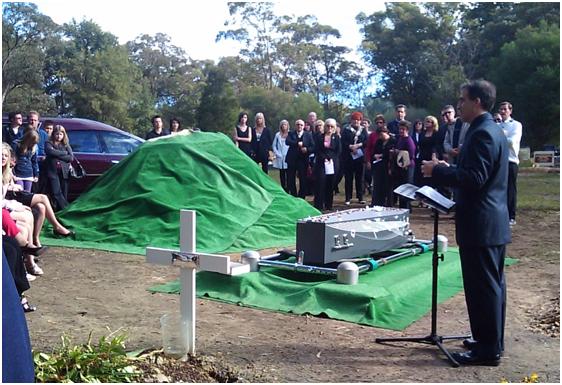
I have seen a lot of coffins, but I had never seen a coffin decorated with piano keys and music notes. Handles for the pall bearers were chrome cylinders attached with piano strings. I liked it. A lot. It was a tasteful expression of Eric’s love for music. While no professional musician, guests spoke of how he listened to, and drank in, and played music on a daily basis.

Before the casket was lowered, instead of throwing in soil, or laying a flower on the casket, people chose a piece of chocolate from a bowl, and placed it on top. I very deliberately placed by piece on B-flat. I don’t know that Eric was so into blues, but it suited my mood on the day.

Later, at the service of celebration, there was a tasteful mix of grief and laughter. Some of Eric’s children spoke, some performed musical pieces, his pastors spoke, guests spoke (more about that tomorrow), and once again, profound hope was expressed in music and song.

I have also seen funeral celebrations turn into a form of crass denial. Where it’s all made out to be a party, where banal humour and christo-pagan superstition permeates proceedings. “Yeah, I bet Bob’s up there now, beer in hand, looking at us all down here, wondering what all the fuss is about and when we’re all gonna get back to work…”

We can all do without that. And really, funerals do more harm than good when they trivialise life like that.

At Eric’s funeral we wrestled with life and its wending course. Together we sought to make sense of Jesus’ claim to be resurrection and life. We did that through our tears. And we celebrated everything Eric had brought into our lives, the talents he used to serve others, the expertise he brought to his workplace, and his quirky style of humour, we were celebrating the work of an extraordinary God in the life of an ordinary man.

But celebration? Seriously? How can you walk out of a funeral more in the lightness of hope than the heaviness of grief? This is the reality of Jesus’ life in us. His is a promise of hope, of life, that cannot be extinguished by death. This is what we have in the good news. When that deep celebration and profound joy resonates, even from a grieving community of followers, resurrection joy is palpable.

This is what we should celebrate at a funeral. How we have seen God’s life come to expression in this person. How we have seen beauty. How we have sensed a pursuit of justice and right. How they showed us a healthy spirituality. How we have learned about relationship, how others have been valued, honoured, and served.

Memories like anchor our affirmation in God’s work of grace in the life of another. We’re reminded that the Gospel is not just a religious idea or a doctrine to be intellectually accepted. It is an invigorating, transforming reality. When these transformational realities take root n a person’s life, they anticipate the new world Jesus will bring: God has already started his work of transformation in his people. Proof positive that Jesus is renewing minds, attitudes and values, and through them bringing change to his world. One life at a time.

Shalom,

Dave

Thoughts Occasioned by a Funeral

Last week we buried Eric. He was a fine person. A good man. A great follower of Jesus. And the first of my youth group generation to die. All that has got me thinking.

I met Eric in 1973 when I started attending his church in Blacktown. My parents had been solid in their faith for years, and had recently decided to switch churches. The church they chose was were Eric and his family attended. I was at a stage in life where I was making big decisions about life direction. I wasn’t being particularly principled about it. I was just in ‘default’ mode. When you are 15 years old, and your parents attend a church where there are no kids your age, there are always going to be more attractive options on a Sunday morning. I did not know it then, but I was at faith’s fork in the road. My parent’s decision to switch was a life saver. The life that was saved was mine.

Looking back now, I see how God used Eric, and a few others, to draw me into faith and followership. They helped me belong. They draw me into a small group who opened the Bible and sought to find its relevance for our lives. It was great. It was real. I came to see how following Jesus could be fun, exciting, and a rich broadening of what it meant to truly live.

At Eric’s funeral I remembered all this. I remarked how we shared a love for music, and great bass lines. He was into keys, I was getting into bass guitar. I remember now that he loved a good Monty Python line. And he loved his trail bike (he had a Kawasaki 250 or something). He let me ride his bike. He even let me ride his bike when I fell off it.

I don’t think Eric was my closest friend, and probably was not his closest friend either. Even so, it was the community, the friendship that Eric and others provided, that became the soil God used to nourish my faith. I am incredibly thankful for that. And I was blessed to have the opportunity to say so at Eric’s thanksgiving service.

Eric was the first of that generation of friends to die. Many of those present had made the same comment. It has given me reason, not only to reminisce, but also to consider life and death, and some of the important aspects of what it means to follow Jesus in such a time as this.

I hope my thoughts will be of value to you.

Shalom,

Dave